

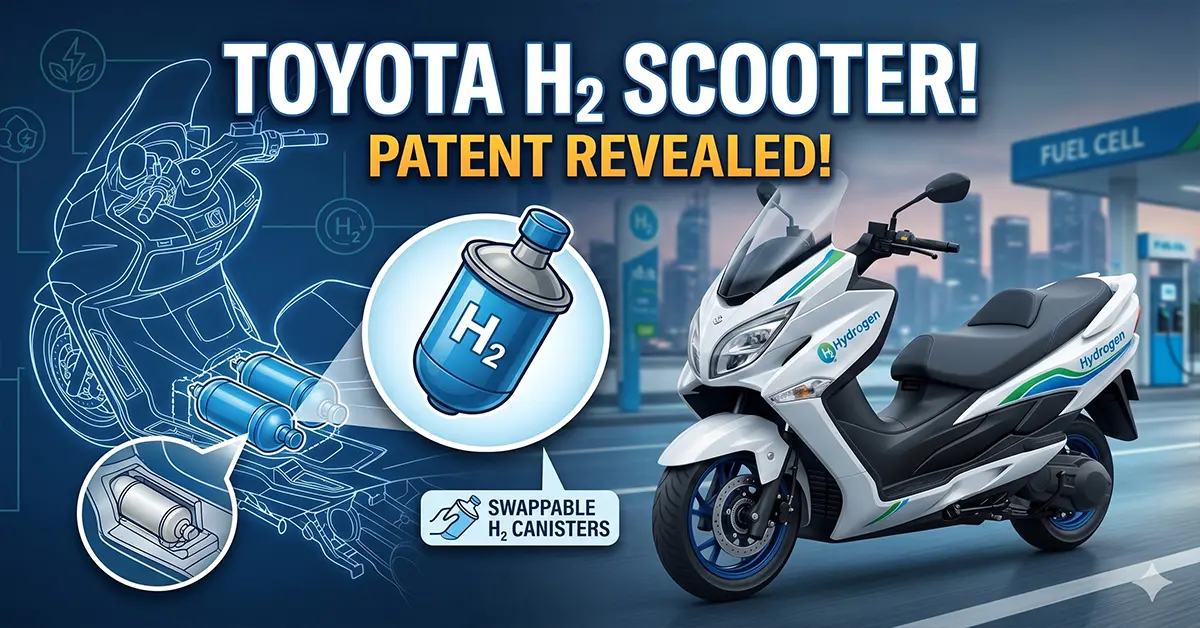
Is the electric scooter era already facing its biggest threat? Toyota, the automotive giant renowned for its hydrogen cars, is officially stepping into the world of urban mobility. With the recently leaked Toyota hydrogen fuel cell scooter patent, the automotive industry is buzzing. In this article, we will unpack everything you need to know about this Suzuki Burgman-based marvel—from its ingenious swappable fuel canisters to its potential to disrupt the EV market. Let’s dive right in!
The Big Reveal: Toyota Enters the Two-Wheeler Game
When you think of Toyota, you likely picture reliable cars, hybrid engines, or the hydrogen-powered Mirai sedan. However, the world’s largest automaker is now thinking small—two-wheeled small. The filing of the Toyota hydrogen fuel cell scooter patent proves that the company is actively exploring alternative green mobility options beyond traditional battery electric vehicles (BEVs).
Instead of following the electric vehicle race blindly, Toyota is leveraging its immense expertise in hydrogen technology to create a zero-emissions commuter vehicle. But they aren’t doing it entirely alone. Toyota is part of the HySE (Hydrogen Small mobility & Engine) initiative, a collaborative project involving leading Japanese manufacturers like Suzuki, Honda, and Yamaha. This coalition is dedicated to solving the complex puzzle of hydrogen-powered small mobility.
Also Read: Avenger 160 Discontinued? New Bajaj Avenger 220 Street 2026 Launch
A Familiar Face: Based on the Suzuki Burgman Platform
One of the most fascinating aspects of this new patent is the design itself. Rather than inventing a completely new chassis from scratch, Toyota has opted for a proven, widely loved architecture. The Toyota hydrogen fuel cell scooter patent heavily borrows the silhouette and platform of the beloved Suzuki Burgman 400.
Here is why this platform choice is a stroke of genius:
- Maxi-Scooter Styling: The Burgman is famous for its large proportions, which naturally provides the ample internal space required to house complex fuel cell components.
- Comfort and Road Presence: It offers a highly comfortable riding posture, making it ideal for both tight city streets and longer highway commutes.
- A Proven Concept: Suzuki previously unveiled a hydrogen fuel cell Burgman prototype back in 2011, and more recently, an internal combustion concept at the 2023 Japan Mobility Show. By using a familiar layout, Toyota reduces the learning curve for everyday riders, ensuring the scooter feels relatable rather than intimidating.
The Game-Changing Innovation: Swappable Hydrogen Tanks
The biggest hurdle for hydrogen vehicles globally has always been the lack of refuelling infrastructure. Finding a high-pressure hydrogen gas station is extremely difficult. Toyota’s brilliant solution? A “coffee pod” approach to refuelling.
According to the latest patent images, the hydrogen-powered scooter features an incredibly clever swappable canister system. Here is how Toyota plans to revolutionize refuelling:
- Floorboard Placement: The hydrogen canisters are placed low around the floorboard area. This keeps the center of gravity low, ensuring the scooter remains highly stable and nimble in heavy traffic.
- Hinged mechanism: Earlier prototypes made the tanks notoriously difficult to reach. Toyota’s new patent introduces a hinge cradle or a scissor linkage arm. This allows the heavy canister to simply swing out to the side for effortless removal.
- Instant Refuelling: Instead of waiting hours for a battery to charge, a rider can simply pull into a station, slide out the empty canister, pop in a pre-filled one, and drive off in seconds.
- Enhanced Safety: Using pre-filled, factory-sealed cylinders eliminates the risk of fuel contamination during transport, which is highly critical for maintaining the efficiency of delicate fuel cells.
Also Read: 2026 Hyundai Creta Interiors Spied: Next-Gen Pleos Connect Tech Revealed
Fuel Cell vs. Hydrogen Combustion (HICE)
It is crucial to understand exactly how this new scooter generates power. While Suzuki’s 2023 concept used a Hydrogen Internal Combustion Engine (HICE)—meaning it literally burned hydrogen gas to create tiny explosions—the Toyota hydrogen fuel cell scooter patent takes a far superior approach.
It utilizes hydrogen fuel cell technology. In this system, the hydrogen from the swappable tank reacts chemically with oxygen from the air inside a fuel cell. This chemical reaction generates electricity, which then spins a silent electric motor to drive the rear wheel.
The advantages of this fuel cell system are massive:
- Zero Emissions mobility: The only byproduct that comes out of the exhaust pipe is pure water vapor. There are zero carbon or nitrogen oxide emissions.
- Higher Efficiency: Fuel cells extract significantly more range from a smaller tank compared to a combustion engine.
- Silent Operation: Because it is powered by an electric motor, the ride is as quiet and smooth as a premium electric scooter.
Will It Rival Electric Scooters Like Ather and Ola?
If this scooter makes it to production, it will undoubtedly shake up the market currently dominated by traditional electric vehicles like the Ola S1 Pro, Ather 450X, and TVS iQube. But how does it compare?
The Advantages Over EVs:
- Zero Charging Downtime: Swapping a canister takes less than 30 seconds, entirely eliminating the “range anxiety” and long waiting times associated with plug-in EVs.
- No Battery Degradation: Lithium-ion batteries lose capacity over time and are expensive to replace. A hydrogen fuel cell system boasts a longer, more consistent lifespan.
The Challenges Ahead:
- Infrastructure: While the swappable tank idea is brilliant, companies still need to build kiosks or stores where riders can actually buy or swap these hydrogen canisters.
- Pricing: Fuel cell technology is currently expensive. The initial price tag of this scooter could be significantly higher than standard petrol or electric alternatives.
Conclusion
The Toyota hydrogen fuel cell scooter patent is much more than just a blueprint; it is a bold statement about the future of green transportation. By combining the legendary comfort of the Suzuki Burgman platform with the cutting-edge convenience of swappable hydrogen tanks, Toyota is proving that batteries aren’t the only solution to sustainable travel. While we might have to wait a few years to see it on the streets, this development guarantees that the future of two-wheelers is going to be incredibly exciting, highly competitive, and remarkably clean.
Also Read: BMW R 1300 GS Adventure Dark Edition Unveiled: Everything You Must Know
FAQs (Frequently Asked Questions)
1. Is the Toyota hydrogen scooter an electric vehicle?
Ans: Yes and no. It does not use a massive plug-in battery. Instead, it uses a hydrogen fuel cell to generate its own electricity on the go, which then powers an electric motor. It drives like an EV, but refuels like a petrol scooter.
2. When will the Toyota hydrogen scooter launch in India?|
Ans: Currently, the vehicle is strictly in the patent and prototype phase. There is no official launch date yet. Given the need for hydrogen infrastructure, a mass-market launch is likely a few years away.
3. Why did Toyota base their scooter on the Suzuki Burgman?
Ans: Toyota and Suzuki are actively collaborating under the HySE (Hydrogen Small mobility & Engine) project. The Suzuki Burgman’s maxi-scooter frame offers the perfect physical dimensions to securely house the hydrogen tanks and complex fuel cell components.
4. Are swappable hydrogen tanks safe for daily use?
Ans: Absolutely. Toyota’s patent focuses heavily on safety. The swappable canisters are designed as rigid, factory-sealed units. The proposed hinged cradle mechanisms ensure that the tanks are securely locked during transit and easily removed without any risk of gas leaks or contamination.
5. How much range will the Toyota hydrogen scooter offer?
Ans: While official figures have not been released, hydrogen fuel cells are highly efficient. Industry experts expect a range that comfortably rivals or exceeds top-tier premium electric scooters, making it perfect for both city commutes and longer rides.