

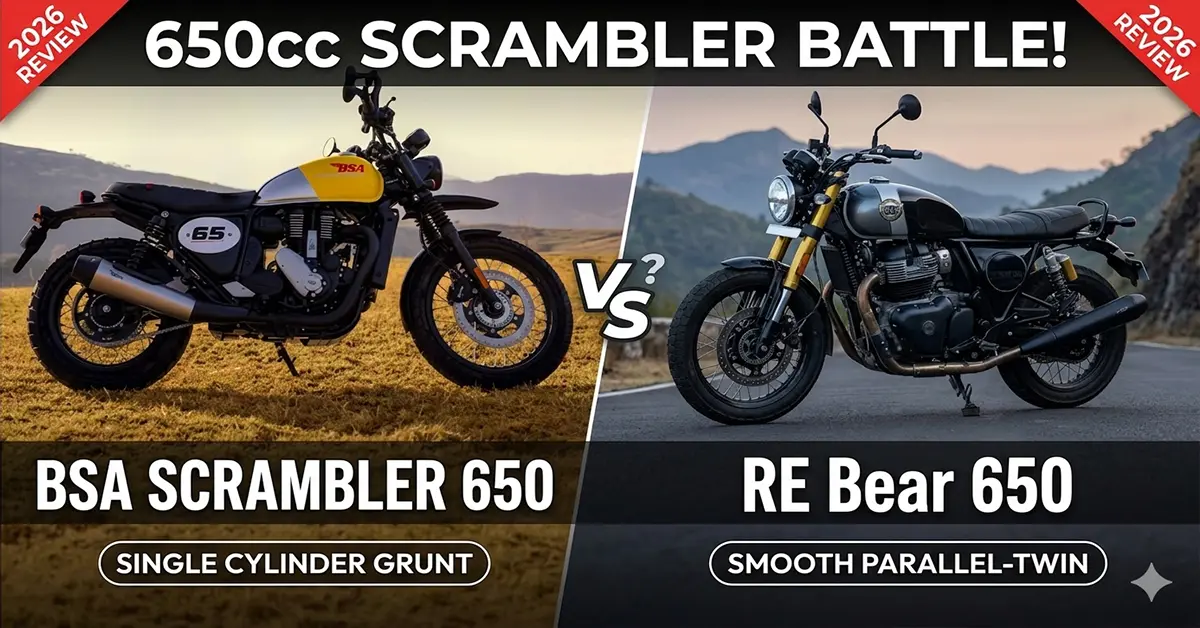
The middleweight motorcycle segment in 2026 has never been more exciting, especially if you are a fan of rugged, old-school aesthetics combined with modern performance. If you are torn between two of the most hyped motorcycles of the year, this ultimate BSA Scrambler 650 vs Royal Enfield Bear 650 comparison is exactly what you need. In this detailed guide, we will break down everything from engine specifications to real-world handling, features, and pricing to help you make the smartest buying decision.
Engine and Performance: Single vs Twin Cylinder
When comparing the best scrambler bikes in India, the engine architecture is where these two machines drastically differ. Although both boast a ~650cc displacement, their power delivery characteristics are entirely unique.
The BSA Scrambler 650 Engine
The newly launched BSA Scrambler 650 utilizes a 652cc, liquid-cooled, single-cylinder engine featuring a DOHC, 4-valve setup.
- Power & Torque: It produces a highly respectable 45.6 bhp at 6,500 rpm and 55 Nm of torque peaking at just 4,000 rpm.
- Transmission: It comes paired with a 5-speed manual gearbox and an assist and slipper clutch.
- Riding Dynamic: Because all that torque is available so early in the rev range, the BSA offers incredible low-end grunt. It pulls effortlessly at lower speeds, making it an absolute joy for city commutes and slow off-road trails.
Also Read: Forget EVs? Toyota Hydrogen Fuel Cell Scooter Patent Revealed
The Royal Enfield Bear 650 Engine
On the other side of the ring, the Royal Enfield Bear 650 borrows the legendary 648cc air/oil-cooled parallel-twin engine from the Interceptor 650 but tunes it for better low-end punch through a visually striking 2-into-1 exhaust system.
- Power & Torque: It generates slightly higher power at 46.8 bhp (47.4 PS) at 7,150 rpm and 56.5 Nm of torque at 5,150 rpm.
- Transmission: Unlike the BSA, the Bear 650 features a 6-speed manual transmission.
- Riding Dynamic: The RE Bear 650 specs highlight a high-revving, incredibly smooth parallel-twin experience. It is substantially better for high-speed highway cruising and achieving a higher top speed without vibration.
Hardware, Suspension, and Ride Dynamics
A true scrambler must handle broken tarmac and light trails with confidence. Let’s look at how their chassis and suspension setups compare.
- Suspension Setup: * The Royal Enfield Bear 650 brings premium hardware to the table with 43mm Showa Upside Down (USD) front forks (130mm travel). However, reviewers note that its twin rear shocks are tuned on the stiffer side.
- The BSA Scrambler 650 sticks to traditional 41mm telescopic front forks but offers greater suspension travel (138mm front, 127mm rear), meaning it absorbs deep potholes and off-road bumps slightly better.
- Weight and Agility: Weight plays a massive role in off-road manoeuvrability. The BSA Scrambler weighs in at 208 kg, making it a full 8 kg lighter than the 216 kg Bear 650. This lighter kerb weight gives the BSA an edge in urban traffic.
- Dimensions for the Rider: The BSA is highly accessible with an 820mm seat height and a slightly better 187mm ground clearance. The Bear 650 is taller with an 830mm seat height and 184mm of ground clearance.
- Wheels and Braking: Both 650cc retro motorcycles ride on a 19-inch front and 17-inch rear wire-spoked wheel setup with tube-type dual-purpose tyres. Braking is handled by large 320mm front discs on both, but the Bear 650 offers a slightly larger rear disc (270mm vs 255mm). Both feature dual-channel ABS.
Also Read: Avenger 160 Discontinued? New Bajaj Avenger 220 Street 2026 Launch
Technology, Features, and Design
In terms of aesthetics, both brands have absolutely nailed the vintage scrambler look, complete with wide handlebars, flat bench seats, and robust profiles. However, the technology package separates them.
Royal Enfield’s Modern Touch
The Bear 650 is packed with modern tech. It features Royal Enfield’s brilliant Tripper Dash—a full-colour TFT display that includes built-in Google Maps navigation, media controls, and Bluetooth connectivity. Additionally, it offers switchable rear ABS, a must-have feature for riders looking to slide the rear wheel on dirt trails.
BSA’s Classic Approach
The BSA Scrambler prefers to keep things strictly old-school. It utilizes a basic digital LCD instrument cluster that provides the essentials (speedometer, fuel gauge, gear indicator) but completely misses out on Bluetooth navigation. However, it compensates with standard Brembo braking components and standard USB charging.
Pricing: Which Offers the Best Value?
When looking at the BSA Scrambler 650 on-road price versus the Bear 650, the winner depends entirely on your budget.
- BSA Scrambler 650 Price: Launched at an introductory ex-showroom price of roughly Rs. 3.25 Lakh (for the Raven Black variant), going up to Rs. 3.41 Lakh.
- Royal Enfield Bear 650 Price: Starts at a premium of Rs. 3.39 Lakh for the Boardwalk White variant and climbs all the way to Rs. 3.59 Lakh for the top-tier Two Four Nine edition.
The BSA undercuts the Royal Enfield by roughly Rs. 14,000 to Rs. 50,000, depending on the variant, making it a highly attractive entry point into the premium 650cc segment.
Conclusion
To wrap up this BSA Scrambler 650 vs Royal Enfield Bear 650 comparison, the choice comes down to engine preference and technology. If you want a torque-heavy, lightweight single-cylinder bike that thrives in the city and saves you a considerable amount of money, the BSA Scrambler 650 is a brilliant choice. However, if you prefer the legendary smoothness of a parallel-twin engine, a 6-speed gearbox for highway touring, and modern tech like TFT navigation, the Royal Enfield Bear 650 is undoubtedly worth the extra premium.
Also Read: 2026 Hyundai Creta Interiors Spied: Next-Gen Pleos Connect Tech Revealed
Frequently Asked Questions (FAQs)
1. Which bike is faster, the BSA Scrambler 650 or the Royal Enfield Bear 650?
Ans: The Royal Enfield Bear 650 is faster. Thanks to its 648cc parallel-twin engine and 6-speed gearbox, it boasts a higher top speed of approximately 165 kmph and feels significantly smoother at triple-digit speeds compared to the single-cylinder BSA.
2. Does the BSA Scrambler 650 have a twin-cylinder engine?
Ans: No, unlike the Royal Enfield, the BSA Scrambler 650 is powered by India’s largest-capacity single-cylinder engine in this segment (652cc, liquid-cooled).
3. What is the real-world mileage of both motorcycles?
Ans: Both motorcycles are quite thirsty due to their large capacities. You can expect a real-world fuel economy of roughly 22 to 25 kmpl from the Royal Enfield Bear 650, while the BSA Scrambler 650 delivers a very similar mileage of around 24 to 26 kmpl, depending on riding conditions.
4. Are these bikes good for short riders?
Ans: The BSA Scrambler 650 is slightly more welcoming for shorter riders due to its 820mm seat height and lower kerb weight (208 kg). The Bear 650’s 830mm seat height and 216 kg weight can be slightly intimidating for riders under 5’6”.
5. Which motorcycle is better for off-roading?
Ans: Both are “soft-roaders” rather than dedicated dirt bikes. However, the Royal Enfield Bear 650 takes a slight edge for dirt enthusiasts because it features switchable rear ABS—allowing you to lock the rear wheel in the dirt—a feature the BSA lacks.