

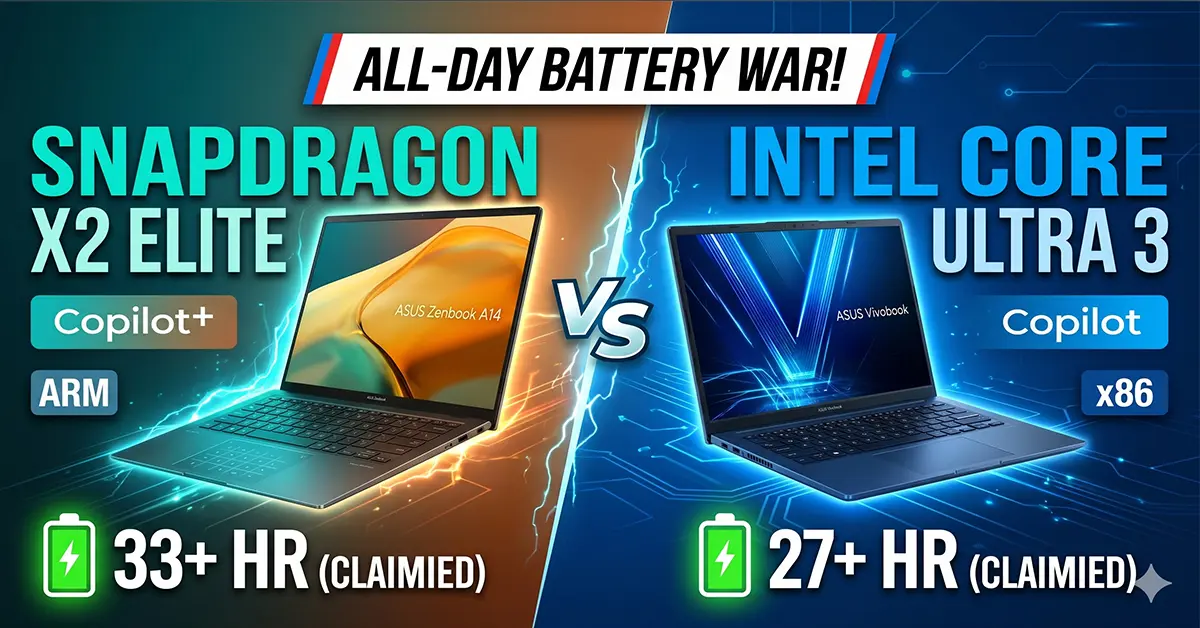
Imagine leaving your laptop charger at home for a two-day business trip—and actually getting away with it. In 2026, the battle for the ultimate laptop battery is no longer just about making it to 5 PM; it’s about surviving the whole weekend. With the recent launch of the Zenbook A14 and the ASUS Vivobook 14, the tech world is hyper-focused on one massive showdown: Snapdragon X2 Elite vs Intel Core Ultra 3 battery life.
If you are currently deciding between Qualcomm’s incredibly efficient ARM architecture and Intel’s triumphant x86 comeback with “Panther Lake,” this breakdown of real-world performance will help you choose the ultimate productivity machine.
The Contenders: ARM Supremacy vs The x86 Comeback
For years, Apple’s M-series chips made Windows users jealous of their unplugged longevity. But the landscape has violently shifted. Today, we are looking at two vastly different approaches to achieving massive power efficiency in premium ultraportables.
The Snapdragon X2 Elite (ASUS Zenbook A14)
Qualcomm shook the industry with their X Elite series, and the newer 18-core Snapdragon X2 Elite pushes the boundaries even further. Found in premium, ultra-thin chassis like the Zenbook A14, this ARM-based architecture is designed from the ground up for mobile efficiency, boasting insane claims of up to 33 hours of offline video playback on its 70 watt-hour battery.
The Intel Core Ultra 3 “Panther Lake” (ASUS Vivobook 14)
Intel has historically struggled with power draw under heavy loads. However, the Intel Core Ultra 3 series (codenamed Panther Lake) is a massive redemption story. Built on the new Intel 18A process node, these chips are aggressively targeting the “x86 battery life king” title. Intel claims that supported designs, like the new Copilot+ ASUS Vivobook 14, can push up to an astonishing 27 hours of video streaming on a single charge.
Also Read: Everything We Know About the Xiaomi Smart Band 10 Pro Clip-On Earbuds
Real-World Battery Performance: The 8-Hour Workday is Dead
Manufacturer claims about video playback are great, but what happens when you open 40 Chrome tabs, run Microsoft Excel, jump on a Zoom call, and keep Slack running in the background? The Snapdragon X2 Elite vs Intel Core Ultra 3 battery life comparison gets incredibly interesting when we look at mixed real-world usage.
1. The Office Productivity Test
When it comes to standard office tasks—web browsing, document editing, and email—both processors easily obliterate the standard 8-hour workday.
- Intel Core Ultra 3: The Vivobook 14 proves that Intel has successfully closed the gap. In active web usage tests, the Core Ultra 3 comfortably hits 15 to 17 hours. You can easily do a full day of work, go home, and use it all evening without reaching for a plug.
- Snapdragon X2 Elite: The Zenbook A14 still holds a slight edge in pure standby time and low-intensity tasks. Because ARM architecture is so efficient at idling, the battery barely drops when you step away from the keyboard. Expect a solid 18 to 20 hours of real-world office productivity.
2. Thermals and Unplugged Performance
Here is where the architecture differences truly shine.
- Snapdragon’s Superior Thermals: The Snapdragon X2 Elite inside the ultra-light Zenbook A14 (weighing under 1kg) runs incredibly cool. Even when pushing the CPU, the fans rarely spin up. More importantly, Qualcomm’s ARM architecture provides unbeatable unplugged longevity without heavily throttling performance. What you get on the charger is largely what you get off the charger.
- Intel’s Balanced Approach: The Intel Core Ultra 3 manages heat far better than previous generations. While it might get slightly warmer than the Snapdragon under heavy multitasking, it rarely gets uncomfortable. However, Intel laptops still tend to manage power a bit more aggressively when unplugged to conserve that 27-hour battery rating.
3. The App Compatibility Factor (The Hidden Battery Drain)
Battery life isn’t just about hardware; it’s about software translation.
- The ASUS Vivobook 14 running the Intel Core Ultra 3 has a distinct advantage: native x86 compatibility. Every legacy Windows application, obscure company software, and indie game runs natively without a translation layer, keeping power draw stable.
- The Zenbook A14 and its Snapdragon X2 Elite run native ARM apps with unbelievable efficiency. However, if you are forced to run a heavy, non-native x86 app through the Prism emulator, you will see a noticeable hit to both performance and battery life.
Also Read: Are Moto Buds 2 Plus the Best TWS Under ₹5,000 in India?
Which Laptop Should You Buy?
The war between the Snapdragon X2 Elite and the Intel Core Ultra 3 proves that consumers are the real winners. The era of carrying heavy power bricks to the coffee shop is officially over.
- Buy the Zenbook A14 (Snapdragon X2 Elite) if: You want the absolute thinnest, lightest, and coolest-running laptop available. If your daily workflow consists of native ARM apps, Microsoft Office, and web browsing, Qualcomm offers unparalleled multi-day battery life and sleep efficiency.
- Buy the ASUS Vivobook 14 (Intel Core Ultra 3) if: You need guaranteed compatibility with every piece of legacy software and game on the market, but refuse to compromise on modern battery standards. Intel has finally delivered an x86 chip that gives ARM a run for its money.
Conclusion
The Snapdragon X2 Elite vs Intel Core Ultra 3 battery life debate isn’t about finding a loser; it’s about celebrating two massive technological leaps. While Intel has successfully optimized the x86 architecture to easily survive a full day of heavy lifting, Qualcomm’s ARM-based Snapdragon X2 Elite continues to dominate in pure unplugged thermal efficiency and multi-day standby time. Whichever you choose for 2026, your charger is going to be gathering a lot of dust.
Also Read: Microsoft Surface Pro 12 Snapdragon X Plus: The Ultimate AI Tablet
Frequently Asked Questions (FAQs)
Q: Does the Intel Core Ultra 3 really get 27 hours of battery life?
Ans: Under highly specific, controlled conditions (like local video playback at lower brightness), the Intel Core Ultra 3 can reach those numbers. However, in real-world mixed usage, expect closer to 15-17 hours, which is still incredibly impressive for an x86 processor.
Q: Is the Snapdragon X2 Elite better than Intel for gaming?
Ans: Generally, no. While the Snapdragon X2 Elite has strong integrated graphics, the Intel Core Ultra 3 (Panther Lake) features superior Arc graphics and native x86 compatibility, meaning games run natively without the performance drops associated with ARM emulation.
Q: Can the Zenbook A14 run normal Windows apps?
Ans: Yes! Windows on ARM uses an emulator called Prism to run standard x86 Windows apps. While most everyday apps run perfectly fine, heavy video editing software or anti-cheat engines in games might struggle or refuse to run.
Q: Which laptop runs cooler, the Zenbook A14 or Vivobook 14?
Ans: The Zenbook A14 with the Snapdragon X2 Elite will generally run cooler and quieter. ARM architecture is inherently more efficient at managing thermals under typical productivity workloads compared to traditional x86 chips.