

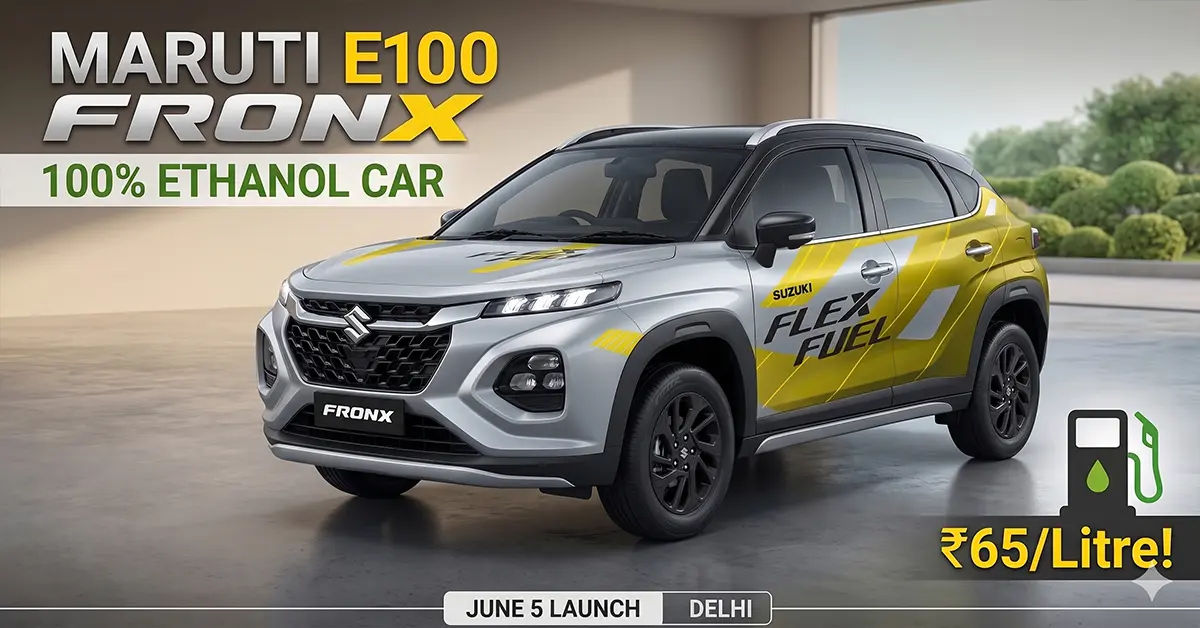
Are you ready to say goodbye to skyrocketing petrol prices? The Indian automotive landscape is on the brink of a massive revolution. Union Minister Nitin Gadkari recently confirmed that the highly anticipated Maruti Suzuki E100 flex-fuel car will be unveiled on June 5, perfectly timed for World Environment Day. This groundbreaking step will introduce India’s first passenger vehicle capable of running entirely on 100% ethanol, transforming green mobility forever.
What is the Maruti Suzuki E100 Flex-Fuel Car?
The upcoming Maruti Suzuki E100 flex-fuel car represents a monumental leap in flex-fuel technology. Unlike standard internal combustion engines designed exclusively for petrol or diesel, a flex-fuel engine can operate on multiple fuel mixtures. Currently, India widely utilises E20 fuel (20% ethanol and 80% petrol). However, the “E100” designation signifies that this specific vehicle can run on pure, 100% bioethanol.
Transitioning to an E100 ethanol-powered vehicle isn’t as simple as changing the fuel pump. Ethanol is inherently more corrosive and absorbs moisture much faster than unleaded gasoline. Therefore, Maruti Suzuki has heavily modified the engine calibration, fuel storage, delivery systems, and internal seals to withstand these higher ethanol concentrations. Industry experts predict these specialised components might increase the vehicle’s manufacturing cost by approximately Rs 40,000 to Rs 50,000, but the massive long-term fuel savings will comfortably outweigh this initial premium.
Also Read: Save Up To Rs 2.70 Lakh With Kia Car Discounts in May 2026
Which Maruti Suzuki Model Will Hit the Roads First?
While the official model name has been kept tightly under wraps ahead of the Delhi launch event, automotive enthusiasts and industry insiders are placing their bets on two incredibly strong contenders.
- Maruti Suzuki Wagon R: The company previously showcased a Wagon R flex-fuel prototype at domestic mobility expos capable of running on E20 to E85 blends. Upgrading this beloved hatchback into India’s first E100 flex-fuel car makes strategic sense due to its undeniable mass-market appeal.
- Maruti Suzuki Fronx: At the Japan Mobility Show, Suzuki turned heads with a stunning Fronx prototype compliant with E85 fuel. Given the massive popularity of compact SUVs in India, launching an upgraded, fully E100-compliant Fronx could capture a massive segment of eco-conscious, modern buyers.
Why India Desperately Needs 100% Ethanol Cars
The shift toward alternative fuel technology is not just an environmental initiative; it is a highly critical economic strategy for the nation. Here is exactly why the government and leading automakers are aggressively pushing for this transition:
- Massive Reduction in Oil Imports: India currently imports an astonishing 87% of its crude oil requirements. By adopting domestic ethanol-powered vehicles, the country will save billions in foreign exchange, strengthening the national economy and enhancing energy security.
- Highly Cost-Effective for Consumers: During his announcement, Nitin Gadkari highlighted that bioethanol currently costs around Rs 65 per litre. When compared to the fluctuating and premium prices of traditional petrol and diesel, everyday commuters will experience massive monthly savings.
- Empowering Local Farmers: Because ethanol is produced from agricultural byproducts like sugarcane and broken rice, farmers will directly benefit. They will actively transition from food growers to energy providers, drastically boosting rural incomes.
- Curbing Toxic Emissions: E100 fuel burns significantly cleaner than traditional fossil fuels. This launch perfectly aligns with the World Environment Day goal to reduce vehicular pollution and significantly lower carbon footprints across crowded Indian metropolises.
Also Read: New-Generation VinFast VF8 Electric SUV Breaks Cover: 500 km Range!
The E100 Fuel Infrastructure: Where Will You Fill Up?
A common, realistic concern among potential buyers is the availability of pure ethanol at local pumps. Acknowledging this, the Indian government has already established a robust, fast-tracked roadmap for E100 dispensing stations. The Ministry of Petroleum and Natural Gas plans to roll out 150 retail outlets in the coming weeks, targeting major hubs like Delhi, Mumbai, Pune, and Nagpur.
Furthermore, within the next 24 months, the government aims to successfully commission over 5,000 dedicated E100 fuel stations across the nation. This rapid infrastructure expansion will perfectly complement the mass rollout of the Maruti Suzuki E100 flex-fuel car, completely eliminating range anxiety for early adopters and daily commuters alike.
Conclusion
The official unveiling of the Maruti Suzuki E100 flex-fuel car on June 5 is so much more than just a new product launch; it is the bright dawn of a sustainable automotive era in India. By perfectly bridging the gap between affordability and eco-friendliness, this vehicle will empower consumers to make greener choices without ever compromising on performance. As the nation confidently steps into this new chapter on World Environment Day, the dream of driving a cost-effective, pollution-free, and proudly indigenous vehicle is finally becoming a reality.
Also Read: BMW X6 M60i xDrive Pre-Bookings India: The V8 Beast is Back!
FAQs (Frequently Asked Questions)
1. When is Maruti Suzuki launching the E100 flex-fuel car?
Ans: Union Minister Nitin Gadkari confirmed that Maruti Suzuki will officially unveil India’s first 100% ethanol-powered passenger vehicle on June 5, coinciding with World Environment Day, at a special programme in Delhi.
2. What does E100 mean in flex-fuel technology?
Ans: E100 refers to 100% pure bioethanol fuel. A vehicle with an E100-compliant engine features specialised fuel lines, robust injectors, and anti-corrosive internal seals that allow it to run entirely on ethanol without needing a single drop of petrol.
3. Which Maruti car will be the first flex-fuel vehicle?
Ans: While the exact production model hasn’t been officially confirmed yet, industry experts heavily speculate it will either be a heavily upgraded version of the popular Wagon R hatchback or the Fronx compact SUV, as both models have previously had flex-fuel prototypes showcased.
4. What is the price of E100 ethanol fuel in India?
Ans: Currently, bioethanol is a highly cost-effective fuel source, priced at approximately Rs 65 per litre. This makes it a vastly cheaper and greener alternative to traditional, expensive petrol and diesel.
5. Will the Maruti Suzuki flex-fuel car cost more than regular petrol cars?
Ans: Yes, initially. The specialised engine components required to safely handle corrosive ethanol and absorb moisture could increase the vehicle’s manufacturing cost by around Rs 40,000 to Rs 50,000. However, the significantly lower daily fuel costs will quickly offset this initial price bump.