

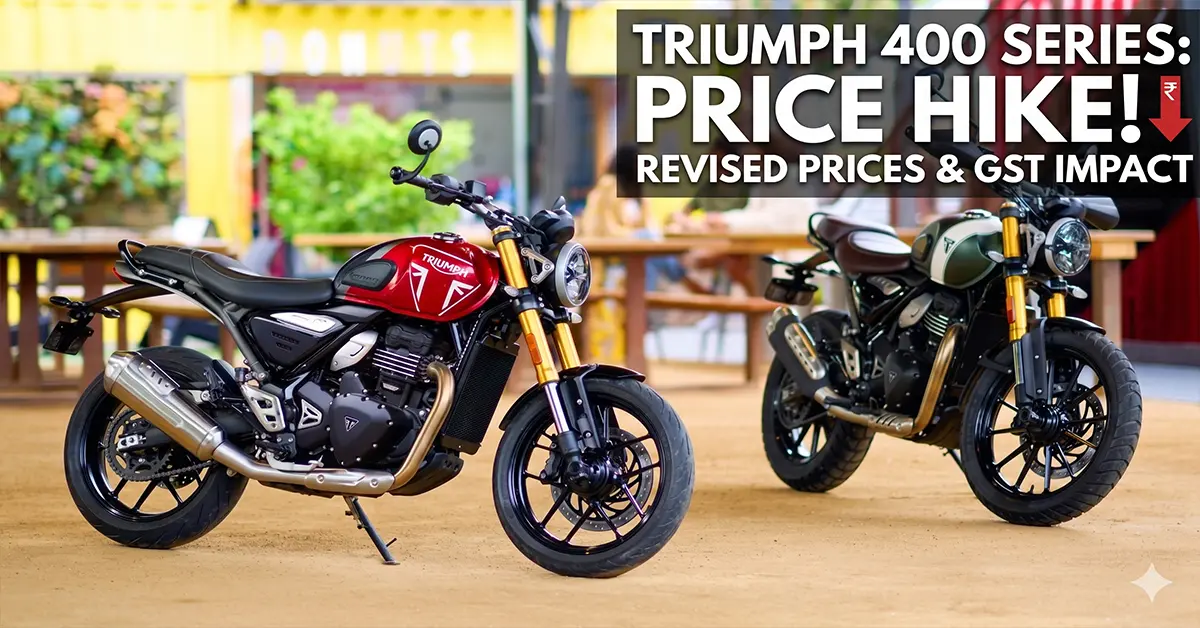
Are you planning to bring home a brand-new Triumph Speed 400 or Scrambler 400 X this year? You might want to finalise your decision fast. A significant Triumph 400 series price hike after GST adjustments has hit the Indian market, shaking up the premium mid-capacity motorcycle segment. In this comprehensive guide, we will break down exactly why these highly popular bikes are getting more expensive, what the new GST rules mean for buyers, and the revised price list you need to know before visiting the showroom.
Understanding the GST Reshuffling in the Motorcycle Segment
To understand the sudden Triumph 400 series price hike after GST adjustments, we first need to look at India’s revised taxation structure for two-wheelers. Under the newly implemented GST 2.0 regulations, the government introduced a sharp dividing line based on engine capacity:
- Below 350cc: Motorcycles falling strictly under the 350cc bracket received a generous tax cut, dropping from the previous 28% down to just 18%.
- Above 350cc: On the flip side, motorcycles with an engine capacity greater than 350cc experienced a severe tax hike, jumping from a combined 31% to a staggering 40%.
This created a massive challenge for brands like Triumph and KTM, whose flagship mid-capacity offerings sat right around the 398cc mark. Suddenly, the highly lucrative Speed 400 and Scrambler 400 X found themselves slapped with a premium tax bracket, fundamentally altering their aggressive pricing strategy in the country.
Also Read: Ultimate 160HP Battle: Kia Seltos vs Tata Sierra Drag Race Results
The Brilliant Engine Downsizing Strategy
When the GST rules first dropped, Bajaj and Triumph played a very smart hand. Instead of passing a massive 9% tax hike directly to consumers, the brands transitioned some of their models into a downsized 350cc platform earlier this year.
This strategic move allowed certain models, like the newly launched Speed T4 and Scrambler 400 XC, to qualify for the much lower 18% GST slab. At launch, this meant massive price cuts of up to ₹11,000 for specific models, heavily undercutting rivals like the Royal Enfield Guerrilla 450 and the Harley-Davidson X440.
However, the honeymoon phase of lower prices was surprisingly short-lived.
The Reality: The Price Advantages Are Now Being Offset
Despite the clever engine downsizing trick, production costs, supply chain adjustments, and premium component sourcing have caught up. The initial benefits of the lower GST bracket are slowly dissolving. Triumph has recently updated its pricing model across the board, proving that a Triumph 400 series price hike after GST adjustments is an inescapable reality for 2026 buyers.
Even the downsized 350cc models, which were supposed to shield consumers from tax burdens, have received noticeable price bumps shortly after their introductory pricing phase ended.
The Revised Price List: How Much More Are You Paying?
If you are walking into a dealership today, here are the new prices (ex-showroom, Delhi) you can expect across the updated Triumph lineup:
- Triumph Speed T4: Originally introduced as the most accessible model at ₹1.95 lakh, the Speed T4 has seen a price bump of roughly ₹4,000, bringing it to ₹1.99 lakh. Interestingly, this makes the downsized T4 slightly more expensive than the older 399cc version sold last year.
- Triumph Speed 400: The crown jewel of the lineup received a moderate price hike of over ₹2,000 to ₹5,200 (depending on inventory timings), placing its new ex-showroom price at roughly ₹2.34 lakh to ₹2.39 lakh.
- Triumph Scrambler 400 X & XC: The rugged Scrambler siblings have also faced the heat. The 400 XC model is now pricier by up to ₹5,000, sitting comfortably at ₹2.94 lakh. The Scrambler 400 X has also seen incremental bumps in 2026, pushing it upwards of ₹2.69 lakh.
- Triumph Thruxton 400: The café racer addition to the family has seen a ₹5,000 hike, taking its asking price to ₹2.70 lakh.
(Note: On-road prices will vary significantly by state due to local RTO charges and insurance.)
Also Read: Yamaha Patents Auto-Downshift Tech: Next-Gen Adaptive Cruise Control
What Does This Mean for Prospective Buyers?
If you have been holding out for a better deal or festive discounts, the current market dynamics suggest that waiting will only cost you more money. Here are three critical takeaways for buyers dealing with the Triumph 400 series price hike after GST adjustments:
- Value for Money Still Exists: Even with the recent ₹2,000 to ₹5,000 hikes, the Speed 400 and Scrambler 400 X remain two of the most heavily equipped motorcycles in their segment. You are still getting a liquid-cooled engine, ride-by-wire throttle, premium upside-down (USD) forks, and top-tier build quality.
- Performance Trade-offs: Buyers need to be aware of the mechanical changes that accompanied the tax evasion strategy. The downsized 350cc engines produce slightly less power than the original 398cc engines. For example, the Speed T4 develops 29 hp (down from 31 hp), and the current 350cc iterations of the Speed 400 make 37 hp (down from the original 40 hp). If you want pure power, the tax burden is unavoidable.
- The Competitor Landscape: Despite the rising costs, Triumph remains highly competitive against the Royal Enfield Classic 350, the Guerrilla 450, and the KTM 390 Duke. Since the KTM 390 series firmly sits in the 40% GST slab without any engine downsizing, its price gap compared to the Triumph 400 series is actually widening, making the Speed 400 look like a steal.
The Future of the Mid-Capacity Segment in India
The Indian government’s firm stance on penalising motorcycles above 350cc is forcing global manufacturers to rethink their entire engineering strategies for the subcontinent. We are already seeing Triumph reportedly working on completely ground-up 350cc architectures specifically to avoid these taxes long-term.
Until those next-generation bikes arrive, the current roster of 350cc and 400cc Triumphs will likely see continuous, albeit minor, upward price corrections as the company balances component inflation against market share goals.
Conclusion
The recent Triumph 400 series price hike after GST adjustments serves as a stark reminder of how rapidly changing government policies can impact the automotive sector. While it is certainly frustrating for consumers to pay more for slightly downsized engines, the truth is that the Triumph Speed 400, Scrambler 400 X, and the new Thruxton 400 still offer unparalleled refinement and brand value for their asking price. If you have your heart set on that modern classic British design, making the purchase sooner rather than later is the smartest financial move you can make in 2026.
Also Read: Is the Mahindra XUV 3XO the Best Compact SUV in 2026?
FAQs (Frequently Asked Questions)
Q1: Why did Triumph increase the price of the Speed 400 and Scrambler 400 X?
Ans: The price increase is largely a ripple effect of the new GST structure in India, which increased taxes on bikes above 350cc to 40%. While Triumph downsized some engines to offset this, rising input costs and the end of introductory pricing led to a recent price hike of roughly ₹2,000 to ₹5,000 across the lineup.
Q2: Has the engine power of the Triumph 400 series been reduced?
Ans: Yes, for some models. To take advantage of the lower 18% GST slab for bikes under 350cc, Triumph transitioned several 400-series bikes to a 350cc platform. The current Speed 400 now produces 37 hp (down from 40 hp), and the entry-level Speed T4 produces 29 hp.
Q3: Are Triumph 400 bikes still worth buying after the price hike?
Ans: Absolutely. Even with a ₹5,000 price increase, the Triumph 400 series offers superior build quality, excellent handling, and premium features (like USD forks and liquid cooling) that make it highly competitive against Royal Enfield and KTM.
Q4: Will KTM 390 prices also increase due to the GST reshuffling?
Ans: The KTM 390 series (which has a 399cc engine) falls directly into the new 40% premium GST slab. However, Bajaj (which manufactures KTM in India) recently stated they would absorb some of the initial GST hike to keep prices competitive, though minor adjustments have been made across the board.
Q5: Should I wait for the prices to drop before buying the Speed 400?
Ans: It is highly unlikely that prices will drop in the foreseeable future. With the new tax slabs firmly in place and inflation affecting production costs, buying the motorcycle now will save you from potential future price hikes later in the year.