

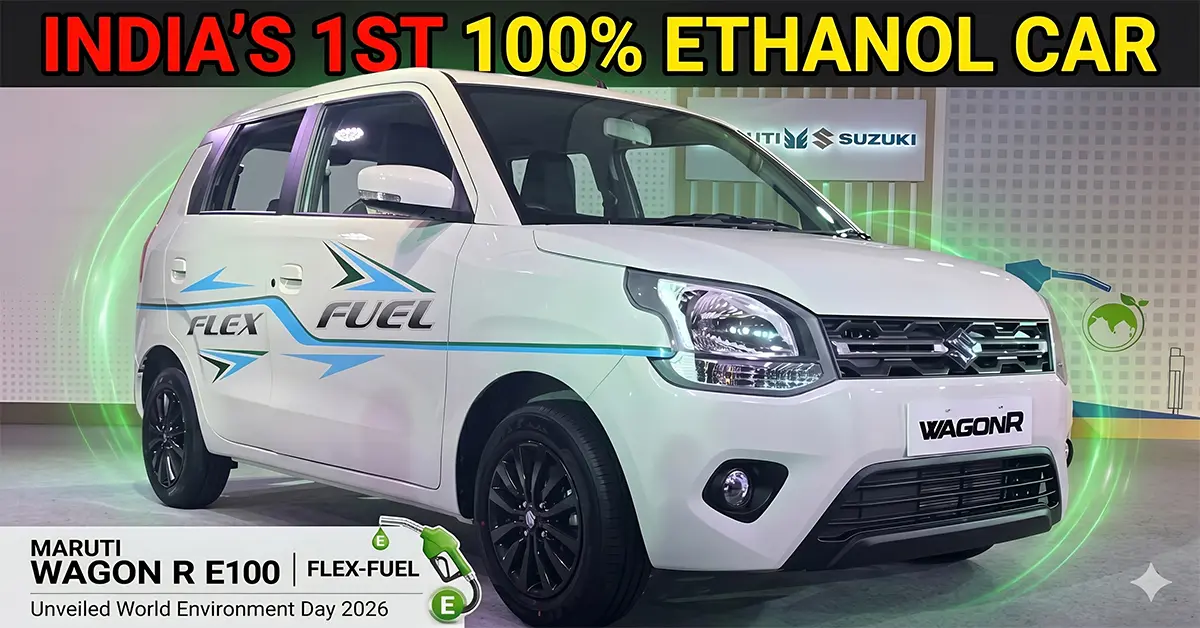
Imagine driving a vehicle that slashes emissions and drastically reduces our reliance on expensive imported crude oil. On the eve of World Environment Day 2026, this became reality. Unveiled in New Delhi, the revolutionary Maruti Suzuki E100 flex-fuel Wagon R marks the launch of India’s first E100 flex-fuel passenger car. Discover its groundbreaking specifications, eco-friendly features, and what this historic shift toward pure ethanol means for everyday Indian drivers!
A Historic Launch for Indian Mobility
On June 4, 2026, India’s automotive landscape changed forever. Unveiled by Union Minister of Road Transport and Highways Nitin Gadkari and Minister of Petroleum and Natural Gas Hardeep Singh Puri, the newest Wagon R prototype transitioned into a production-ready marvel.
While the industry has heavily pivoted toward electric vehicles (EVs), Maruti Suzuki has consistently backed a “multi-pathway” strategy. By introducing a mass-market flex-fuel vehicle capable of running on 100% pure ethanol, the automaker is offering a highly practical, affordable, and immediate solution to combat carbon emissions.
Also Read: Ultimate 160HP Battle: Kia Seltos vs Tata Sierra Drag Race Results
What Makes the E100 Wagon R Different? (Key Engineering Specs)
Switching a standard internal combustion engine to run on high ethanol blends is no simple task. Ethanol is more corrosive than petrol and inherently harder to ignite at lower temperatures. To overcome these hurdles, the Maruti Suzuki E100 flex-fuel Wagon R features heavy mechanical engineering upgrades tailored specifically for the Indian climate.
Here is what powers this revolutionary ethanol E100 car:
- Advanced Powertrain: It is powered by Maruti’s proven 1.2-litre, four-cylinder K12N petrol engine, heavily modified to support alternative fuels.
- Ultimate Fuel Flexibility: The intelligent engine calibration allows the car to run on any blend of fuel, from standard E20 petrol versions (20% ethanol) all the way up to 100% pure ethanol (E100).
- Heated Fuel Rail Tech: To solve the issue of cold starting on pure ethanol, the engine includes a specialised heated fuel rail system.
- Corrosion Resistance: The fuel pumps, injectors, and fuel lines have been fully upgraded with specialised materials to resist ethanol’s corrosive properties.
- Real-Time Ethanol Sensors: An advanced Electronic Control Unit (ECU) works with inline sensors to instantly detect the ethanol percentage in the tank and adjust the injection mapping seamlessly.
Familiar Exterior, Modern Interior Features
Despite the futuristic technology under the hood, Maruti Suzuki wisely kept the beloved family-car appeal intact.
Exterior Highlights
The vehicle retains the iconic tall-boy stance and wide grille that Indian families love. To differentiate it from the standard models, this mass-market flex-fuel vehicle features exclusive side decals and a distinct “BioFlex” badge gracefully placed on the rear tailgate. Sporty blacked-out alloy wheels and simple flap-style door handles complete the practical yet stylish profile.
Cabin and Technology
Step inside, and the flex-fuel Wagon R feels identical to its premium petrol counterparts.
- Infotainment: A 7-inch touchscreen infotainment system with wired Android Auto and Apple CarPlay.
- Aesthetics: A dual-tone cabin with beige and black accents, accented by silver garnishes around the AC vents and a three-spoke steering wheel.
- Safety First: It doesn’t skimp on security, offering up to six airbags, ABS with EBD, electronic stability control (ESC), and hill hold assist (HHA).
Also Read: Is the Mahindra XUV 3XO the Best Compact SUV in 2026?
The Environmental and Economic Impact
Why is the Indian government pushing so hard for this ethanol blending target? The answer lies in economics and environmental preservation.
Currently, India imports nearly 90% of its crude oil, which heavily drains foreign exchange reserves and leaves the economy vulnerable to global geopolitical shocks. By shifting to domestically produced ethanol—which is derived from sugarcane and agricultural biomass—India can drastically slash these import bills.
Moreover, this fuel transition is a massive win for the environment. Operating on E85 or E100 fuel slashes tailpipe emissions by an impressive 79% compared to traditional petrol, significantly improving local air quality in congested cities like New Delhi and Mumbai. Additionally, creating a massive new market for ethanol will directly boost the incomes of millions of Indian farmers who supply the raw materials.
Expected Pricing and Availability
Currently, the ecosystem for E100 fuel in India is in its early stages. Therefore, Maruti Suzuki will initially roll out the flex-fuel Wagon R exclusively for the commercial segment (yellow plate vehicles). This strategic move will give companies like Indian Oil time to expand pure ethanol availability across national fuel stations.
Because of the specialised flex-fuel hardware, industry experts estimate a price premium of ₹40,000 to ₹50,000 over the standard petrol variants. Consequently, the ex-showroom price is expected to hover around ₹8.00 lakh to ₹8.50 lakh.
Conclusion
The launch of the Maruti Suzuki E100 flex-fuel Wagon R is a landmark achievement that proves sustainable driving doesn’t have to rely solely on battery power. As India’s first E100 flex-fuel passenger car, it perfectly balances the everyday practicality of a beloved hatchback with the groundbreaking environmental benefits of renewable biofuels. By bridging the gap between agriculture and automotive innovation, this car isn’t just driving on ethanol—it is driving India toward a self-reliant, greener future.
Also Read: Maruti & Tata Win Big: May 2026 VAHAN Passenger Vehicle Sales Data
FAQs (Frequently Asked Questions)
1. What is a flex-fuel vehicle (FFV)?
Ans: A flex-fuel vehicle has an internal combustion engine designed to run on more than one type of fuel, usually a mixture of standard petrol and ethanol. The vehicle’s smart sensors automatically adjust the engine settings based on the exact fuel blend in the tank.
2. Can the Maruti Suzuki E100 Wagon R run on normal petrol?
Ans: Absolutely. The highly advanced ECU and fuel sensors allow the vehicle to seamlessly operate on any blend of fuel ranging from standard E20 petrol all the way up to 100% ethanol (E100), giving drivers complete peace of mind.
3. What is the expected price of the Wagon R Flex Fuel?
Ans: While official consumer pricing hasn’t been announced, it is expected to launch around ₹8.00 lakh to ₹8.50 lakh (ex-showroom). The slight price bump accounts for the upgraded, corrosion-resistant fuel injectors and heated fuel rails.
4. Why is ethanol considered an eco-friendly fuel?
Ans: Ethanol is a renewable biofuel produced from plant materials like sugarcane and agricultural waste. Using it as a primary fuel can reduce toxic greenhouse gas tailpipe emissions by nearly 79%, resulting in cleaner air and a much smaller carbon footprint.