

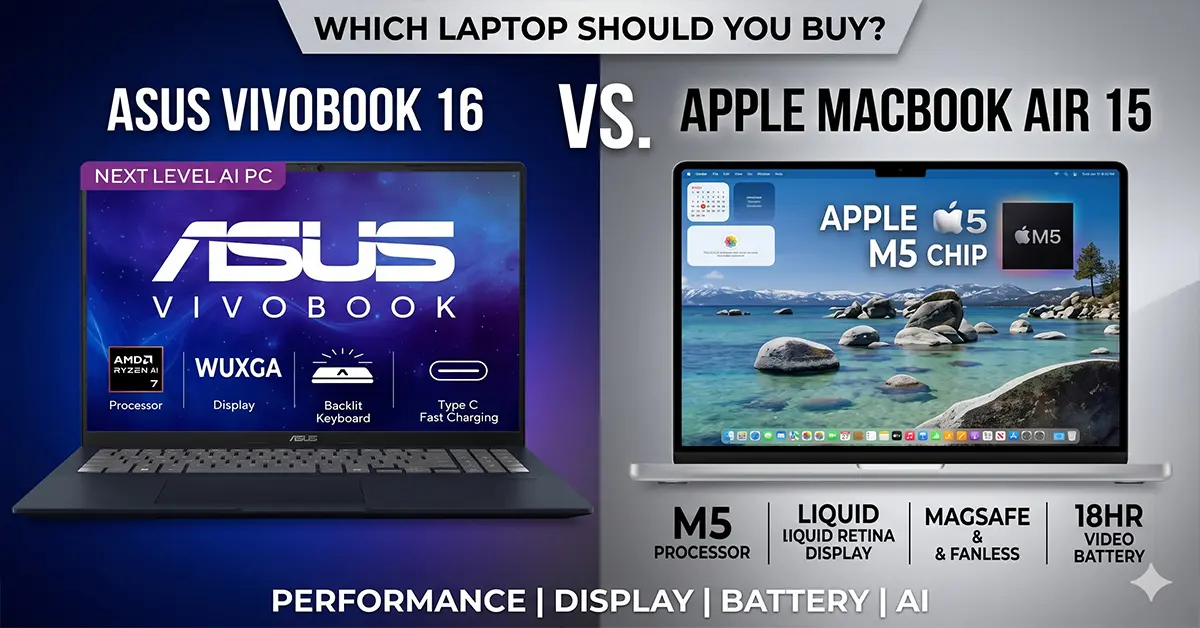
Tech forums are ablaze comparing two of the year’s most anticipated laptops. If you are stuck deciding between the bleeding-edge Windows world and the refined Apple ecosystem, you are not alone. In this definitive guide to the Asus Vivobook 16 vs Apple MacBook Air 15 M5, we break down performance, display quality, and battery life. By the end, you will know exactly which laptop deserves your money.
The Dawn of 2026’s Productivity Titans
When upgrading your daily driver in search of the best productivity laptops 2026, the market offers an incredible blend of raw processing power and localized AI capabilities. On one side, we have the newly listed Asus Vivobook 16 (2026), relying on the cutting-edge AMD Ryzen AI 7 445 processor. On the opposing end is the ultra-sleek Apple MacBook Air 15, armed with the heavily anticipated Apple M5 silicon. Specs on paper only tell half the story. Let’s explore how they actually compare in real-world usage.
Performance Breakdown: AMD Ryzen AI 7 445 vs Apple M5 Chip
If you are looking for a deep Ryzen AI 7 445 vs Apple M5 comparison, the real battleground for these productivity machines lies under the hood.
- Asus Vivobook 16 Powerhouse: Powered by the AMD Ryzen AI 7 445, this Windows laptop boasts 6 powerful cores and 12 threads, clocking up to 4.6GHz. More importantly, it features an AMD XDNA NPU delivering up to 50 TOPS. This makes it a certified Copilot+ PC, excelling at localized AI tasks, rapid photo editing, and background noise cancellation.
- Apple MacBook Air 15 Dominance: The Apple M5 chip brings a highly efficient 10-core CPU and a robust 10-core GPU, paired with a 16-core Neural Engine. Operating on an incredible 153GB/s memory bandwidth, the M5 handles intensive graphic workflows and Apple Intelligence flawlessly. Its fanless design ensures absolute silence.
Also Read: Snapdragon X2 Elite vs Intel Core Ultra 3: The All-Day Battery War Heats Up
Display and Visual Experience: WUXGA NanoEdge vs Liquid Retina
If you stare at a screen for hours, display quality is non-negotiable.
- Vivobook’s Expansive Screen: Asus provides a stunning 16-inch WUXGA NanoEdge IPS display, featuring a 1920×1200 resolution and a 16:10 aspect ratio. The slim bezels and 180-degree hinge create a flexible experience that multitaskers will love.
- MacBook’s Retina Brilliance: When evaluating M5 MacBook Air specs, Apple counters with a premium 15.3-inch Liquid Retina display. Sporting a superior 2880×1864 native resolution and 500 nits of brightness, it offers deeper contrast and sharper text. However, Apple’s insistence on a 60Hz refresh rate on the Air line feels slightly outdated compared to Windows competitors.
Connectivity, Battery Life, and Portability
A laptop’s value ultimately comes down to daily usability and battery endurance.
- Port Selection: The Asus Vivobook 16 2026 easily wins the connectivity war. It offers practical ports including USB-A, USB-C, an HDMI output, and a 3.5mm audio jack. The Apple MacBook Air 15 M5 maintains a minimalist aesthetic, offering just two Thunderbolt 4 ports and MagSafe 3 charging.
- Battery Endurance: Apple reigns supreme in battery life. The new M5 model delivers an astounding 18 hours of video playback. The Asus Vivobook provides around 10 to 12 hours. It guarantees a full workday, but Apple still holds the crown.
- Portability: Despite its 16-inch screen, the Asus remains relatively light at 1.70kg. The MacBook Air retains its ultra-thin aluminium chassis, making it slightly easier to travel with.
Also Read: Microsoft Surface Pro 12 Snapdragon X Plus: The Ultimate AI Tablet
Software Ecosystems: Copilot+ PC vs macOS Tahoe
The latest 2026 laptop trends emphasize operating systems integrated seamlessly with AI. The Asus runs on Windows 11 and leverages its Copilot+ PC status to automate repetitive tasks natively. Conversely, the MacBook introduces macOS Tahoe, which brings enhanced ecosystem integration, the Universal Clipboard, and deep-rooted Apple Intelligence to streamline your workflow.
The Final Verdict: Which Should You Buy?
Reading any Asus Vivobook 16 2026 review will tell you that choosing between the Asus Vivobook 16 vs Apple MacBook Air 15 M5 depends on your workflow. If you require expansive screen real estate, versatile port options, and top-tier Windows AI integration at a more accessible price point, the Asus Vivobook 16 with the AMD Ryzen AI processor is a phenomenal choice. However, if your priority is absolute silence, unmatched battery life, a premium aluminium build, and seamless integration with your iPhone, the Apple M5 MacBook Air remains the undisputed king of premium ultraportables. Make your choice based on what maximizes your daily productivity!
Also Read: Apple MacBook Neo A18 Pro Price in India Drops to ₹61,990!
Frequently Asked Questions (FAQs)
1. Is the Asus Vivobook 16 (2026) good for heavy multitasking?
Ans: Yes. Equipped with the powerful AMD Ryzen AI 7 445 processor and fast RAM, the Vivobook handles heavy multitasking, browser tab hoarding, and localized AI workloads incredibly well without significant slowdowns.
2. Does the Apple MacBook Air 15 M5 have a cooling fan?
Ans: No, the MacBook Air 15 (M5) retains Apple’s signature fanless design. The exceptional thermal efficiency of the Apple M5 chip allows it to perform heavy productivity tasks silently without overheating.
3. Which laptop offers better battery life: M5 MacBook Air or Vivobook 16?
Ans: The Apple MacBook Air 15 M5 offers superior battery life, boasting up to 18 hours of usage. The Vivobook provides a solid all-day battery, but Apple’s silicon remains noticeably more power-efficient.
4. Are there enough ports on the MacBook Air 15 M5 for office work?
Ans: The MacBook Air features only two Thunderbolt 4 ports. If your office setup relies on legacy USB-A ports or HDMI connections, the Asus Vivobook 16 is the much more convenient option unless you buy a USB-C hub.
5. What is the display refresh rate of the M5 MacBook Air 15?
Ans: The Apple MacBook Air 15 M5 features a standard 60Hz Liquid Retina display. While highly colour-accurate and incredibly bright, it lacks the higher refresh rates found in competing premium laptops.