

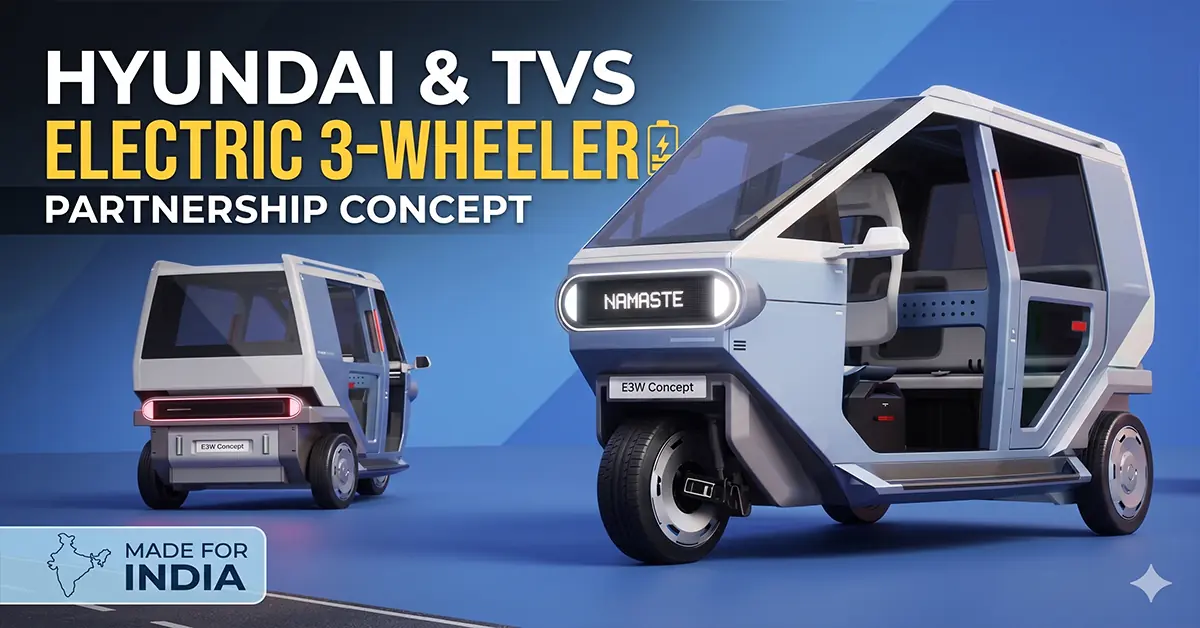
Are you ready to see a massive revolution in India’s daily commutes? Imagine the global engineering excellence of a car giant combined with the unmatched local expertise of India’s top two-and-three-wheeler maker. The newly signed Hyundai and TVS electric 3-wheeler partnership promises exactly that. In this article, we will break down everything you need to know about this game-changing alliance and how it will redefine commercial electric mobility for millions.
Why Hyundai and TVS Joined Forces
The recently formalized Hyundai and TVS electric 3-wheeler partnership is a historic milestone for India’s automotive industry. While the initial seed was planted back in 2018 during discussions between the Indian Prime Minister and Hyundai’s leadership, the two giants officially signed a Joint Development Agreement (JDA) in April 2026. Their shared mission? To co-develop state-of-the-art battery-powered three-wheelers that tackle India’s unique urban transport challenges.
By blending Hyundai’s world-class R&D and human-centric design approach with TVS Motor’s robust electric platforms and deep understanding of the local market, they are creating a commercial product truly built for the masses. This strategic move also directly supports the government’s ongoing push to curb urban pollution and reduce dependence on fossil fuels.
Key Roles in the Mega EV Collaboration
This collaboration isn’t just about sharing a logo; it is a highly strategic division of expertise aimed at dominating the competitive commercial electric vehicles sector:
- Hyundai’s Role: Leading the overall vehicle concept design, contributing advanced global mobility technologies, and ensuring premium safety and ergonomic standards that are often missing in standard commercial three-wheelers.
- TVS Motor’s Role: Spearheading the engineering execution, utilizing its established electric mobility platforms, managing massive local manufacturing operations, and driving both domestic sales and future exports to emerging economies.
Also Read – MG Majestor Launch Delayed: Toyota Fortuner Rival Price Reveal Pushed to April 27
Groundbreaking Features of the Upcoming E3W
First showcased as a visionary concept at the Bharat Mobility Global Expo 2025, the upcoming commercial EV will pack incredible, India-specific features that operators and commuters have long desired:
- Adaptive Ground Clearance: Specifically engineered to easily navigate heavily waterlogged and aggressively uneven, monsoon-affected Indian roads without compromising stability.
- Advanced Thermal Management: A highly optimized battery cooling system explicitly designed to protect the electric drivetrain from India’s scorching tropical heat, ensuring longevity and efficiency.
- Modular Interiors: Flexible seating configurations that allow seamless transitions between everyday passenger transport, heavy-duty cargo delivery, and even rapid-response emergency services.
- Enhanced Safety & Ergonomics: High-end safety systems and driver-friendly cabins built to reduce fatigue for drivers enduring incredibly long daily shifts in last-mile mobility solutions.
The Push for 100% Localization and Economic Growth
A major highlight of this sustainable transportation initiative is the aggressive push for localization. Major vehicle components will be sourced and manufactured strictly within India. This strategic “Make in India” move drastically cuts down overall production and retail costs, making the vehicles highly accessible to fleet owners and independent auto drivers. Furthermore, it strengthens the domestic automotive supply chain, generates vital local employment, and guarantees that spare parts and rapid after-sales services are always available to the end customer.
Conclusion
The Hyundai and TVS electric 3-wheeler partnership is far more than just a standard business deal; it is a monumental leap toward cleaner, smarter, and highly efficient urban transport. By merging international innovation with unparalleled local resilience, these two powerhouse brands are geared to introduce reliable zero-emission vehicles that will undeniably shape the future of India’s roads. As they move from the concept phase to rigorous testing and mass production, buyers can get ready to experience an electrifying, affordable, and highly dependable change in everyday travel!
Also Read – Bold & Dark: 2026 Hyundai Venue Knight Edition Launched Starting at ₹9.70 Lakh
FAQs
Q1: What is the main goal of the Hyundai and TVS partnership?
A: The primary goal is to co-develop and manufacture highly advanced, affordable electric three-wheelers tailored specifically for India’s fast-growing last-mile mobility sector, with potential plans for future export to other emerging global markets.
Q2: When was this EV partnership officially signed?
A: After successfully showcasing a futuristic E3W concept at the Bharat Mobility Global Expo in 2025, Hyundai and TVS officially signed the Joint Development Agreement (JDA) in April 2026 to begin full-scale production.
Q3: Who will manufacture these new electric 3-wheelers?
A: While Hyundai is leading the design, concept, and global R&D aspects, TVS Motor Company will utilize its vast infrastructure to handle the localized manufacturing, engineering, and sales distribution across India.
Q4: Will these electric autos be suitable for rough Indian roads?
A: Absolutely! They feature an innovative adaptive ground clearance system for monsoon roads, specialized thermal management for incredibly hot weather, and a highly durable build quality rigorously tested for challenging Indian driving conditions.