

Imagine pulling up to the fuel station and pumping mostly alcohol into your car instead of petrol. Sounds futuristic? It is happening much sooner than you think. Following the successful nationwide rollout of E20 petrol in April 2026, the government is already accelerating its biofuel mission. In a major shift toward true energy independence, India drafts new regulations for E85 fuel to tackle volatile global oil prices and severe urban pollution. This comprehensive guide uncovers exactly what an 85% ethanol blend means for your vehicle’s engine, your daily mileage, and your wallet.
Why India is Shifting Gears to E85 Fuel in 2026
The Indian automotive sector is undergoing a massive transformation. With the initial 20% blending target officially achieved ahead of the original 2030 schedule, the Ministry of Road Transport and Highways is not slowing down. But what exactly is prompting this aggressive timeline?
What is E85 Fuel?
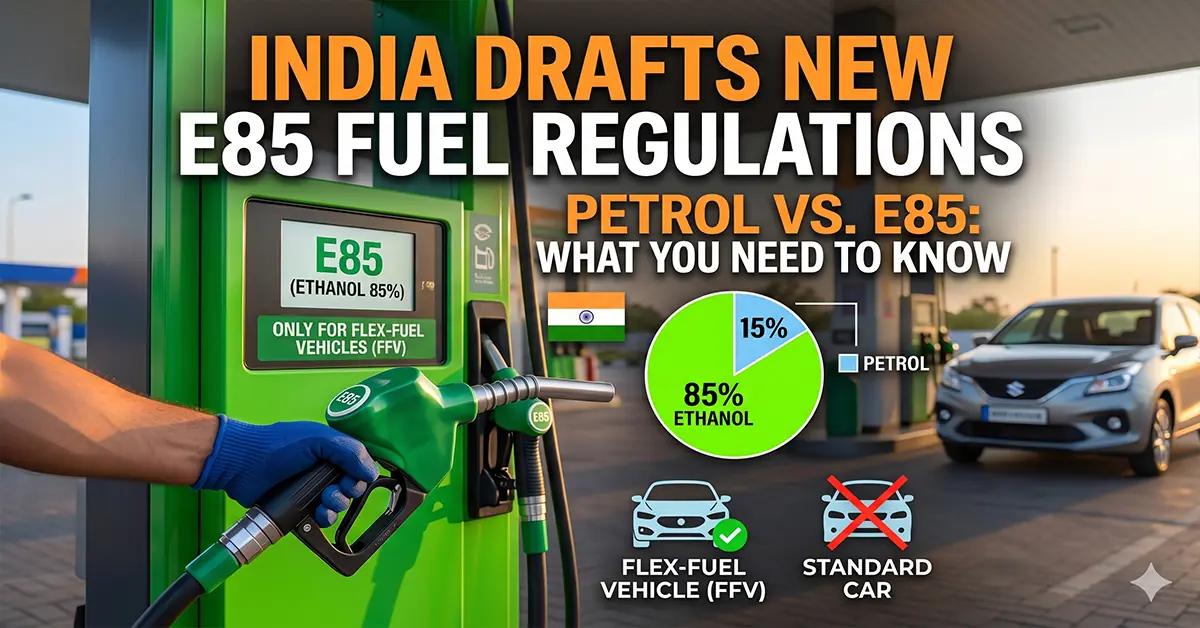
E85 is an advanced, highly potent biofuel blend consisting of 85% ethanol and 15% petrol. Unlike the standard E10 or E20 blends that currently run in most modern vehicles, E85 possesses a completely different chemical profile. Because ethanol is highly corrosive and behaves differently under pressure, it strictly requires specialized flex-fuel vehicles (FFVs) equipped with robust fuel lines, specific sensors, and advanced engine mapping to run effectively.
Also Read: Inside the Kia Vision Meta Turismo EV Concept: The Future of Driving?
The Core Reasons Behind the E85 Push
The push for higher ethanol blending targets 2026 is driven by several pressing macroeconomic factors:
- Crude Oil Independence: India currently imports roughly 85% of its crude oil. With recent geopolitical tensions in West Asia continuously threatening global supply chains, the government is treating energy security as a top national priority.
- Massive Environmental Benefits: Ethanol blending burns significantly cleaner than traditional fossil fuels. It dramatically lowers greenhouse gas emissions and particulate matter, offering a highly effective, localized solution to India’s urban smog crisis.
- Boosting the Rural Economy: Ethanol in India is primarily derived from sugarcane, maize, and agricultural waste. Scaling up to E85 will create massive localized demand, directly putting money back into the pockets of Indian farmers.
What the Draft Regulations Mean for Car Owners
As India drafts new regulations for E85 fuel, officials are focusing heavily on standardizing testing frameworks and ensuring the automotive market is genuinely ready. Here are the critical takeaways from the highly anticipated E85 regulations draft:
- Dedicated Fuel Dispensers: Because E85 cannot be mixed into standard petrol, it will be introduced as an entirely separate fuel grade. Expect to see dedicated E85 nozzles and separate underground storage tanks at fuel stations to prevent catastrophic consumer misfuelling.
- The Rise of Flex-Fuel Vehicles: The government is urging automakers to rapidly accelerate commercial production. Top companies have already showcased impressive FFV prototypes at major auto expos. The new draft will lay down the exact technical, durability, and emission parameters these vehicles must meet before hitting the showrooms.
- Addressing the Mileage Drop: Ethanol has roughly 30% less energy density than pure petrol. This means that while E85 has a higher octane rating (resulting in smoother, cleaner engine performance), it will yield lower fuel economy. Industry experts are actively discussing potential tax incentives and lowered GST rates for petrol alternatives in India to offset this mileage gap for the everyday consumer.
Also Read: Kia Syros EV India Launch Date and Expected Price (Under ₹15 Lakh?)
Will Your Current Car Run on E85?
The straightforward answer is absolutely not. If you own a standard vehicle purchased before the imminent flex fuel vehicles India rollout, you must strictly stick to E20 petrol. Pumping E85 into a standard engine will rapidly degrade rubber seals, corrode metal components, and ultimately lead to complete engine failure. A standard car simply cannot compute the unique air-to-fuel ratio required for such high alcohol content.
Conclusion
The automotive landscape is evolving at a breakneck pace. As India drafts new regulations for E85 fuel, the nation is taking a monumental leap toward sustainable, self-reliant energy. While this ambitious transition will undoubtedly require massive infrastructure upgrades and the widespread adoption of flex-fuel cars, the long-term benefits for the environment and the economy are undeniable. The era of pure petrol is slowly fading away—make sure you stay informed and ready for the flex-fuel revolution.
Also Read: Expected Features of Honda City Facelift and ZR-V Hybrid SUV in India
Frequently Asked Questions (FAQs)
1. What is the main difference between E20 and E85 fuel?
Ans: E20 contains 20% ethanol and 80% petrol, a blend that most modern vehicles manufactured after 2023 can handle easily. In contrast, E85 contains up to 85% ethanol and requires specially engineered flex-fuel vehicles (FFVs) to operate safely without destroying the engine.
2. When will E85 fuel be officially available at Indian fuel pumps?
Ans: While the government is finalizing the regulatory testing frameworks in 2026, widespread commercial availability is expected to take a couple of years. The rollout will be phased, allowing fuel stations sufficient time to install dedicated E85 dispensers and storage tanks.
3. Will using E85 fuel damage my current car’s engine?
Ans: Yes, absolutely. Using E85 in a standard, non-flex-fuel engine will cause severe corrosion to rubber hoses, plastic seals, and internal metal parts. It will also cause cold-starting issues and eventual engine failure. Only use E85 if your car is explicitly badged as an FFV.
4. Is E85 fuel cheaper than regular petrol in India?
Ans: Because ethanol is produced domestically from agricultural by-products, the raw cost of E85 is generally lower than imported crude oil. However, because it delivers lower mileage per litre, the overall running costs tend to balance out. The government is currently exploring tax incentives to make it more financially appealing to buyers.