

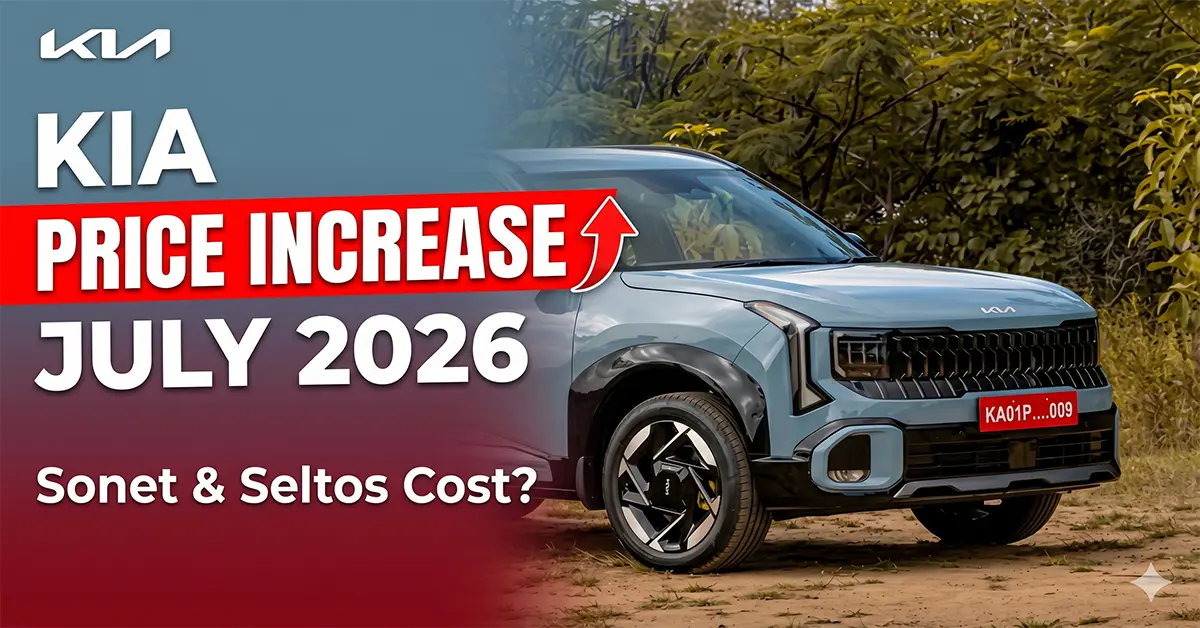
Are you planning to drive home a brand-new Kia this summer? If so, you might want to finalise that booking before the end of the month. Kia India has officially announced a Kia car price hike in July 2026, making its entire lineup more expensive starting July 1st. But exactly how much more will you have to pay, and what is driving this sudden increase? In this article, we will break down everything you need to know about this upcoming price revision, including the reasons behind it and how it will impact popular models like the Seltos, Sonet, and the newly launched Syros.
Why is Kia Increasing Car Prices in July 2026?
The decision to increase vehicle prices is never taken lightly by automakers, especially in a highly competitive market like India. According to official statements from Kia India, the upcoming Kia car price hike in July 2026 is driven by two primary factors:
- Rising Input Costs: The automotive industry worldwide is currently grappling with the continued inflation of essential raw materials. The costs of steel, aluminium, and plastics have seen a steady upward trajectory. Additionally, the complex supply chain involving semiconductors and advanced electronic components remains expensive.
- Increased Operational Expenditure: Beyond the raw materials, the day-to-day costs of manufacturing, logistics, and transportation have also increased. Automakers are spending more to ensure smooth operations and delivery networks.
Kia India has stated that they have absorbed a significant portion of these escalating cost pressures internally for as long as possible to protect their customers. However, to maintain their profit margins and continue investing in future technologies (like their expanding EV portfolio), passing a fraction of this burden to the consumer has become inevitable.
It is also important to note that this is part of a broader industry trend. Major players like Tata Motors, Maruti Suzuki, and Hyundai have also recently announced price hikes for similar reasons, indicating that the entire Indian automotive sector is facing the same economic pressures.
Also Read: Inside the New 2026 Citroen eC3X: Is It Better Than the Tata Punch EV?
How Much Will the Prices Increase?
Kia has confirmed an upward revision of up to 2 per cent across its entire model range. However, this doesn’t mean a flat 2% increase on every single car.
The exact quantum of the hike will vary depending on two main factors:
- The Specific Model: Premium and flagship vehicles are likely to see a larger absolute price jump compared to entry-level models.
- The Chosen Variant: Fully loaded, top-spec variants might experience a slightly higher percentage increase than the base trims of the same model.
Kia has emphasised that despite the increase, they are committed to ensuring that the overall value proposition of each vehicle is maintained.
Impact on the Kia India Portfolio
The revised pricing structure, effective July 1, 2026, will apply to Kia’s complete lineup in India, which includes both Internal Combustion Engine (ICE) vehicles and Electric Vehicles (EVs). Here is a look at the models affected:
- Kia Sonet: Currently starting at Rs. 7.33 Lakh (ex-showroom), Kia’s most affordable offering will see a slight bump. This compact SUV remains a massive volume driver, contributing to 36% of their total sales.
- Kia Syros: The recently updated Syros, which starts at Rs. 8.42 Lakh, will also be affected by the price revision.
- Kia Seltos: As the brand’s biggest seller (accounting for over 41% of sales), the Seltos, currently priced between Rs. 10.99 Lakh and Rs. 19.99 Lakh, is expected to see a noticeable absolute increase, particularly on the higher-end X-Line trims.
- Kia Carens & Carens Clavis: The popular MPV and its Clavis variants, heavily favoured by Indian families, will become marginally more expensive.
- Kia Carnival: The premium MPV offering will see a price adjustment.
- The EV Lineup (EV6 & EV9): Being premium imported or highly localised products, the flagship EV9 (currently priced around Rs. 1.3 Crore) and the EV6 will likely experience the largest absolute price increase due to the 2% hike.
(Note: All current prices mentioned are ex-showroom and subject to change upon the official release of the revised price list on July 1st.)
Also Read: Say Goodbye to Petrol! Hero MotoCorp Complete Flex-Fuel Lineup 2028
What Should Prospective Buyers Do?
If you are in the market for a Kia vehicle, the current scenario presents a brief, closing window of opportunity.
- Finalise Bookings Before June Ends: To secure the current, pre-hike pricing, prospective buyers must finalise their vehicle bookings and ideally complete the invoicing process before June 30, 2026.
- Consult Local Dealerships: Speak directly with your local Kia dealership. They can provide the most accurate information regarding current stock availability, wait times, and whether a booking made now will guarantee price protection against the July 1st hike.
- Evaluate Long-Term Value: While a 2% increase adds to the immediate acquisition cost, Kia models are known for their robust resale value, premium features, and strong after-sales network, which often offset minor initial price differences over the vehicle’s lifespan.
Looking Ahead: What’s Next for Kia in India?
Despite the price adjustments, Kia is not slowing down its momentum in the Indian market. Having recently crossed the massive milestone of 1.5 million vehicle sales in just seven years, the brand is highly focused on expansion.
Based on current industry expectations and testing sightings, Kia is heavily investing in the future. We can anticipate the launch of the Syros EV (their first mass-market electric SUV) expected around August 2026. Furthermore, they are looking to introduce their first hybrid offering in India, the Sorento Hybrid, which is currently undergoing testing and is anticipated for a 2027 launch, targeting the premium three-row SUV segment.
Also Read: Is the 6-Seater Safe? Tesla Model Y L 5-Star ANCAP Safety Rating
Conclusion
The Kia car price hike in July 2026 is an unavoidable reality driven by the macroeconomic pressures of rising raw material costs and operational expenses facing the entire auto industry. While an increase of up to 2% will make models from the Sonet to the EV9 slightly more expensive, Kia’s transparent communication and prior absorption of costs show a commitment to their customer base. If you are determined to purchase a Kia, acting swiftly before the end of June is your best strategy to avoid the impending price jump. Ultimately, with their strong product lineup and upcoming EV and Hybrid models, Kia’s position in the Indian market remains incredibly robust, even with slightly higher price tags.