

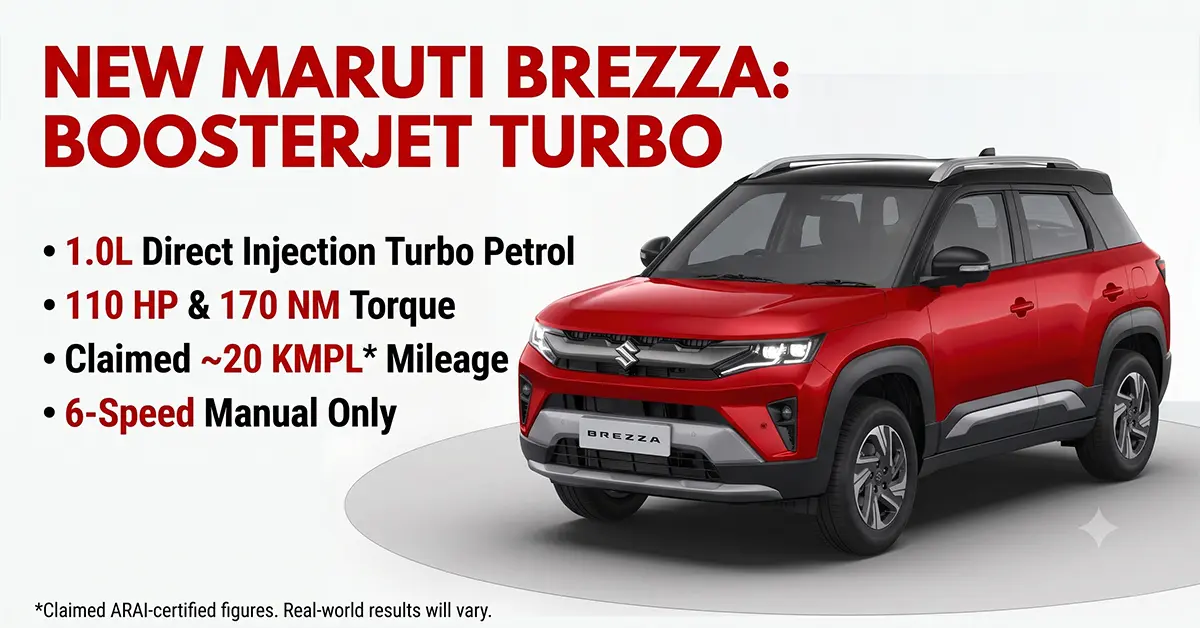
Maruti Suzuki has finally done something the Brezza’s rivals have been doing for years — it’s put a proper turbocharged petrol engine under the bonnet. The new Maruti Brezza Boosterjet turbo engine isn’t a concept or a rumour anymore; it’s here, it’s official, and it changes how this SUV drives. If you’re trying to figure out what this engine actually means for you, this breakdown covers the real numbers, not just the marketing lines.
Why This Engine Matters for the Brezza
For three years, the Brezza soldiered on with just its naturally aspirated 1.5-litre K15C petrol engine while competitors like the Kia Sonet, Hyundai Venue, and Tata Nexon offered turbo-petrol options with noticeably punchier low-end performance. That gap is now closed.
As of July 2026, Maruti Suzuki has officially launched the updated Brezza with a new 1.0-litre direct-injection turbo-petrol engine, badged ‘Boosterjet,’ priced from an introductory Rs 7.40 lakh (ex-showroom) for the turbo variant. This single addition is arguably the biggest change to the second-generation Brezza since it launched.
Engine Specifications: What’s Actually New
The Boosterjet name isn’t new to Maruti’s lineup — it first appeared on the Baleno RS back in 2017 and was later revived in a mild-hybrid, localised form for the Fronx. What’s interesting is that the version now going into the Brezza is tuned differently.
Here’s how the outputs compare:
| Application | Power | Torque | Transmission |
| Maruti Fronx (existing) | 99 bhp | 148 Nm | 5-speed MT / 6-speed AT |
| Maruti Brezza (2026) | ~110 bhp | 170 Nm | 6-speed MT only |
That’s a meaningful step up over the Fronx’s tune of the same engine, suggesting Maruti has recalibrated the turbo for a bit more mid-range shove — useful in a slightly heavier SUV body. According to launch-day coverage from Indian auto publications in July 2026, the engine is paired exclusively with a new 6-speed manual gearbox; there’s no automatic option with the turbo motor at launch, which may disappoint buyers who wanted a torque-converter or AMT pairing.
Key Technical Highlights
- Direct fuel injection for better combustion efficiency and throttle response compared to older port-injection turbo units.
- 170 Nm of peak torque, arriving lower in the rev range than the 1.5-litre NA engine can manage — this is what actually makes city driving and highway overtaking feel less strained.
- New 6-speed manual gearbox, replacing the older 5-speed unit across the Brezza lineup, including on the naturally aspirated variants.
- The 1.5-litre K15C petrol engine continues alongside the turbo option, so buyers still get a choice, including a 6-speed automatic — but only on the NA engine, not the turbo.
Real-World Impact: Mileage and Drivability
One of the biggest questions buyers ask about any turbo-petrol SUV is whether the performance gain costs them at the fuel pump. Based on the certified figures released around the July 2026 launch, the Boosterjet-powered Brezza returns a claimed mileage of 19.96 kmpl on the higher-spec ZXi and ZXi+ variants, and 20.47 kmpl on the LXi and VXi trims.
That’s a genuinely strong number for a turbo-petrol engine in this segment — most rivals’ turbo units hover in the 18-19 kmpl range on paper. In practical, real-world city driving with AC running, expect that figure to realistically settle 3-4 kmpl lower, which is standard for any petrol SUV regardless of what’s written on the brochure.
Maruti has stated it expects fuel efficiency to stay around the 20 kmpl mark, depending on variant and driving conditions — a claim that lines up with the certified ARAI-style figures reported at launch.
What Else Changed Alongside the Engine
The turbo motor didn’t arrive alone. Maruti bundled several updates into this facelift to justify the “new generation” feel:
- 10.1-inch touchscreen infotainment with wireless Android Auto and Apple CarPlay, borrowed from the larger Victoris SUV.
- Ventilated front seats — a genuinely useful addition for Indian summers, and previously missing from the Brezza’s segment-leading rivals.
- Ambient lighting for a more premium cabin feel at night.
- Six airbags, ABS with EBD, electronic stability control, hill-hold control, and a 360-degree camera as part of an upgraded safety package.
- A 5-star Bharat NCAP crash-test rating on select variants, which matters a lot for family buyers cross-shopping this segment.
- A new underbody CNG tank, borrowed from the Victoris, improving boot space practicality on CNG variants compared to the older cylinder-in-boot setup.
Should You Wait for the Turbo Variant?
If your priority is punchy performance and you’re comfortable with a manual-only gearbox, the Boosterjet turbo is the more engaging choice — the extra torque genuinely helps in stop-start traffic and while merging onto highways. If you prefer an automatic gearbox or want the slightly lower running costs of a naturally aspirated engine, the 1.5-litre K15C with its 6-speed torque converter automatic remains the more relaxed option.
For CNG buyers specifically, note that the turbo-petrol engine option currently doesn’t extend to CNG; that setup continues with the 1.5-litre NA engine.
Disclaimer: Specifications, prices, and mileage figures mentioned are based on official launch information and industry reporting as of July 2026. These may be revised by Maruti Suzuki, and actual real-world mileage will vary based on driving conditions, load, and maintenance. Always confirm final on-road pricing and specifications with your nearest Maruti Suzuki dealership before purchase.
Frequently Asked Questions
1. What is the Maruti Brezza Boosterjet engine?
Ans: It’s a new 1.0-litre, direct-injection turbo-petrol engine added to the Brezza lineup in 2026. It produces roughly 110 bhp and 170 Nm of torque, and is paired exclusively with a 6-speed manual gearbox.
2. Is the Brezza turbo engine the same as the Fronx’s?
Ans: It’s based on the same Boosterjet 1.0-litre unit used in the Fronx, but Maruti has retuned it for more output — around 110 bhp and 170 Nm in the Brezza versus 99 bhp and 148 Nm in the Fronx.
3. Does the Brezza turbo-petrol come with an automatic gearbox?
Ans: No. At launch, the turbo-petrol engine is offered only with a 6-speed manual transmission. If you want an automatic, you’ll need to pick the 1.5-litre naturally aspirated petrol variant with its 6-speed torque converter.
4. What mileage does the new turbo Brezza give?
Ans: Claimed mileage figures are 19.96 kmpl for the ZXi and ZXi+ variants, and 20.47 kmpl for the LXi and VXi variants, based on figures released at the July 2026 launch.
5. What is the price of the 2026 Brezza turbo-petrol?
Ans: The turbo-petrol variant starts at an introductory price of Rs 7.40 lakh (ex-showroom). Maruti Suzuki has not yet revealed prices for the higher trims or the naturally aspirated and CNG variants.
6. Is the turbo engine available with CNG?
Ans: No, currently the CNG option is paired only with the 1.5-litre naturally aspirated K15C petrol engine, not the Boosterjet turbo unit.
The Bottom Line
The Boosterjet turbo engine is the single most significant update the Brezza has received since it first launched, and it finally puts Maruti’s compact SUV on equal footing with turbo-petrol rivals it had been trailing on paper. Whether it’s the right pick for you comes down to a simple trade-off: more low-end punch and a manual-only gearbox, versus the smoother, automatic-friendly naturally aspirated option that’s stuck around for a reason.
If you’re currently comparing compact SUVs, it’s worth test-driving both Brezza powertrains back-to-back before deciding — the difference in how they feel in daily traffic is bigger than the spec sheet alone suggests. Found this breakdown useful? Share it with a friend hunting for their next SUV, or check out our detailed review of the full 2026 Brezza facelift.