

Have you noticed your daily commute suddenly feeling much heavier on your wallet? If you fueled up your car today, you already felt the pinch. Effective May 15, 2026, the massive fuel price hike in India 2026 officially broke a four-year streak of steady rates. With petrol, diesel, and CNG getting significantly dearer overnight, let’s explore exactly what this major shift means for your daily motoring budget and overall lifestyle.
The End of a Four-Year Freeze: Unpacking the Rs 3.29 Hike
For the past four years, Indian motorists enjoyed a rare period of price stability at the fuel pumps. Since the last major revision in 2022, state-owned oil marketing companies maintained steady rates, acting as a crucial buffer for the middle class. However, this recent announcement marks a sharp and noticeable shift in our economy.
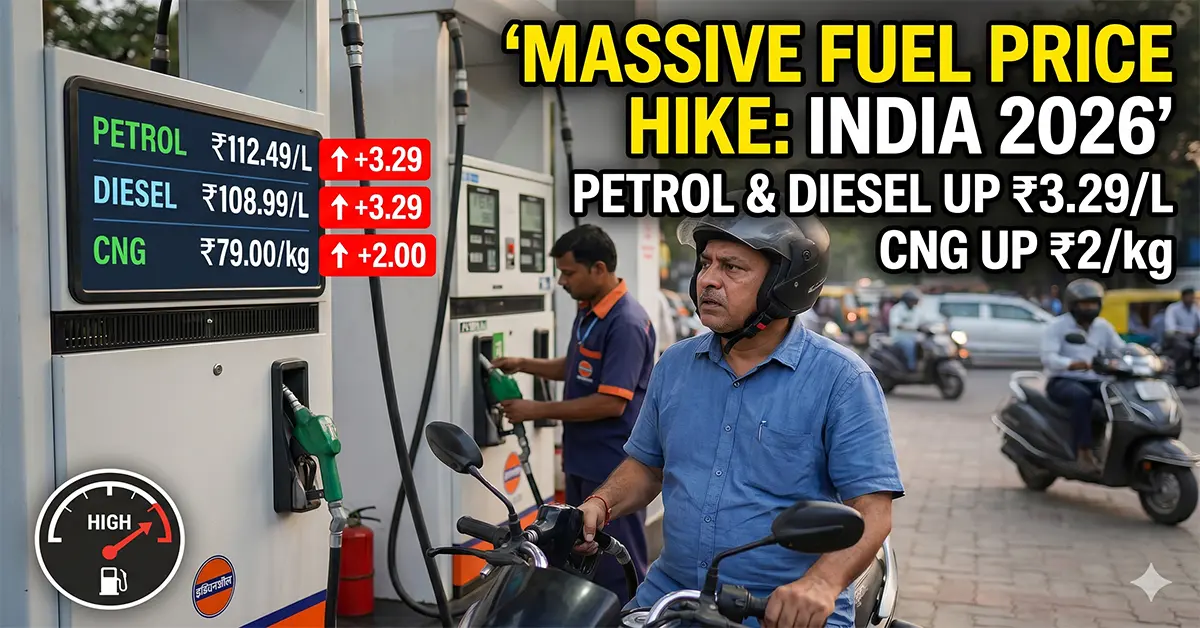
Here is the exact breakdown of the newly revised rates:
- Petrol Prices: Surged by up to Rs 3.29 per litre across major Indian cities like Delhi, Mumbai, Bengaluru, and Chennai.
- Diesel Prices: Increased in tandem with petrol, seeing an identical jump of up to Rs 3.29 per litre, hitting logistics and freight operations hard.
- CNG Prices: Often considered the ultimate budget-friendly alternative, CNG is now costlier by Rs 2 per kg, directly impacting auto-rickshaw drivers, cab operators, and daily commuters.
This petrol and diesel price increase in India is not just a statistical change; it is a direct blow to household budgets that were already battling persistent inflationary pressures.
Also Read: Why the Tata Altroz CNG Automatic is the Ultimate City Car (From ₹8.69L)
Why Did We See a Massive Fuel Price Hike in India 2026?
Many citizens are wondering why this sudden jolt occurred after such a prolonged period of relief. The reasons are a combination of complex global economics and domestic timing.
1. Global Crude Oil Turmoil
Tensions in the West Asia region have sent massive shockwaves through the international energy markets. As global supply chain anxieties heighten, the cost of importing crude oil into India has risen significantly.
2. Currency Fluctuations
Foreign exchange rates play a pivotal role. Recent fluctuations of the Indian Rupee against the US Dollar mean that purchasing oil costs more in local currency, leaving oil companies with little financial padding.
3. Mounting Under-Recoveries
State-owned oil companies, including IOCL, BPCL, and HPCL, have absorbed high global oil prices for years. To prevent further financial bleed and manage mounting under-recoveries, passing the burden to the end consumer became inevitable.
4. Post-Election Revisions
Economic experts highlight that fuel prices were artificially suppressed during recent political cycles. With the political dust settling, the government and oil firms have returned to transparent, market-aligned pricing structures.
Also Read: Honda NX500 E-Clutch Price in India: Is It Worth It?
The Ripple Effect: How This Impacts Your Daily Budget
The recent Indian economy fuel inflation will not stay confined to the fuel stations. Historically, whenever diesel prices spike, a domino effect triggers across various consumer sectors.
- Costlier Groceries: Trucks and freight carriers run primarily on diesel. An increase of Rs 3.29 per litre translates directly to higher transportation costs for fresh produce, FMCG goods, and daily essentials. Expect your weekly grocery bill to inch upwards very soon.
- Commuting Costs: If you rely on ride-hailing apps like Ola or Uber, prepare for fare surges. Cab drivers who utilize CNG are already feeling the heat of the Rs 2 per kg hike, which will inevitably be passed down to passengers.
- Personal Motoring: A family that consumes 50 litres of petrol a month will now spend roughly Rs 165 extra just on fuel. Over a year, this chips away nearly Rs 2,000 from your hard-earned discretionary savings.
How to Navigate the Rising Fuel Costs Today
While you cannot control the daily fuel rates in major Indian cities, you can certainly adapt your lifestyle to minimize the financial sting. Here are a few actionable strategies:
- Embrace Carpooling: Sharing rides to the office not only halves your fuel expenses but also dramatically reduces urban traffic congestion.
- Switch to Public Transit: Metro networks and electric buses in metropolitan cities offer highly subsidized, comfortable, and fast travel alternatives.
- Maintain Optimal Tire Pressure: A simple yet highly effective trick. Under-inflated tires increase drag and lower your car’s overall fuel efficiency by up to 3%.
- Smooth Driving Habits: Avoid aggressive acceleration and sudden braking. Smooth driving can improve your vehicle’s mileage by an impressive 15 to 30 percent on highways.
Conclusion
The abrupt rise in petrol, diesel, and CNG prices signifies a challenging period for the everyday Indian consumer. The massive fuel price hike in India 2026 officially ends a comforting four-year era of steady motoring costs, bringing the harsh realities of global crude oil fluctuations right to our doorsteps. While the Rs 3.29 per litre increase might seem daunting initially, adopting fuel-efficient habits and smart commuting strategies can help you comfortably navigate these turbulent economic waters. Stay informed, drive smart, and budget wisely!
Also Read: Mahindra AI Voice Agents for XUV 7XO Launch: A Game-Changer in Auto Tech?
Frequently Asked Questions (FAQs)
Q1: What is the exact petrol and diesel price hike in India as of May 15, 2026?
Ans: Effective May 15, 2026, state-owned oil companies have officially increased the price of both petrol and diesel by up to Rs 3.29 per litre across all major Indian cities.
Q2: Why did fuel prices increase after a four-year steady streak?
Ans: The sudden price hike is primarily driven by rising international crude oil prices due to West Asia geopolitical tensions, compounded by oil marketing companies needing to recover sustained financial losses after keeping prices frozen since 2022.
Q3: Has the price of CNG also increased in 2026?
Ans: Yes, unfortunately. Along with standard petrol and diesel, CNG prices have also seen a noticeable hike of Rs 2 per kg, affecting both private vehicle owners and public transport operators nationwide.
Q4: Will this fuel price hike increase the cost of everyday groceries?
Ans: Absolutely. Because commercial trucks rely heavily on diesel, the recent Rs 3.29 per litre hike will naturally increase freight and transportation costs. This usually leads to a slight rise in the market prices of vegetables, fruits, and everyday FMCG products.
Q5: Is there a chance of a price rollback soon?
Ans: Immediate rollbacks are highly unlikely given the volatile global crude scenarios. Government interventions via excise duty cuts could offer slight relief later if inflation rises, but motorists should prepare for these higher rates to stay.