

If you are planning a summer road trip or rely on daily inter-city commutes, your travel budget is about to change. The NHAI toll rate hike in India April 2026 is officially rolling out, bringing increased user fees across the nation’s major expressways and national highways. Starting midnight on April 1, 2026, motorists will not only face higher charges but also a strict transition to fully cashless toll plazas. Here is everything you need to know about the new rates, the FASTag annual pass changes, and how to navigate the new rules seamlessly.
Why is the NHAI Increasing Toll Taxes in 2026?
Every financial year, the National Highways Authority of India (NHAI) revises its user fee structures. The NHAI toll tax increase in 2026 is part of an annual adjustment mechanism directly linked to inflation and the Wholesale Price Index (WPI).
The government utilizes this revenue to fund the continuous maintenance, repair, and expansion of critical road infrastructure across the country. For the 2026-2027 financial year, the toll rate revision translates to an average increase of 3% to 5% across various vehicle categories. While regular passenger cars (Light Motor Vehicles or LMVs) will see a marginal bump, commercial vehicles, multi-axle trucks, and buses will bear a slightly heavier burden.
It is important to note that these hikes are standard contractual obligations embedded in the public-private partnership (PPP) models of modern Indian expressways. The goal is to ensure that world-class corridors remain safe, well-lit, and structurally sound for millions of daily commuters.
Also Read – Maruti Suzuki e-Vitara Launched at ₹11 Lakh: Is the Battery Rental Plan Worth It?
Major Expressways Affected by the April 1 Toll Hike
The upcoming toll hike will impact dozens of toll plazas across multiple states, heavily affecting popular routes. Here is a detailed breakdown of how the highway toll charges in India 2026 will look on some of the country’s busiest corridors:
1. Delhi-Meerut Expressway
The Delhi Meerut expressway toll rate is seeing an average increase of 5%. The NHAI has implemented a highly efficient closed tolling system here, meaning you are charged strictly based on the actual distance you travel, calculated via advanced FASTag readers at entry and exit points.
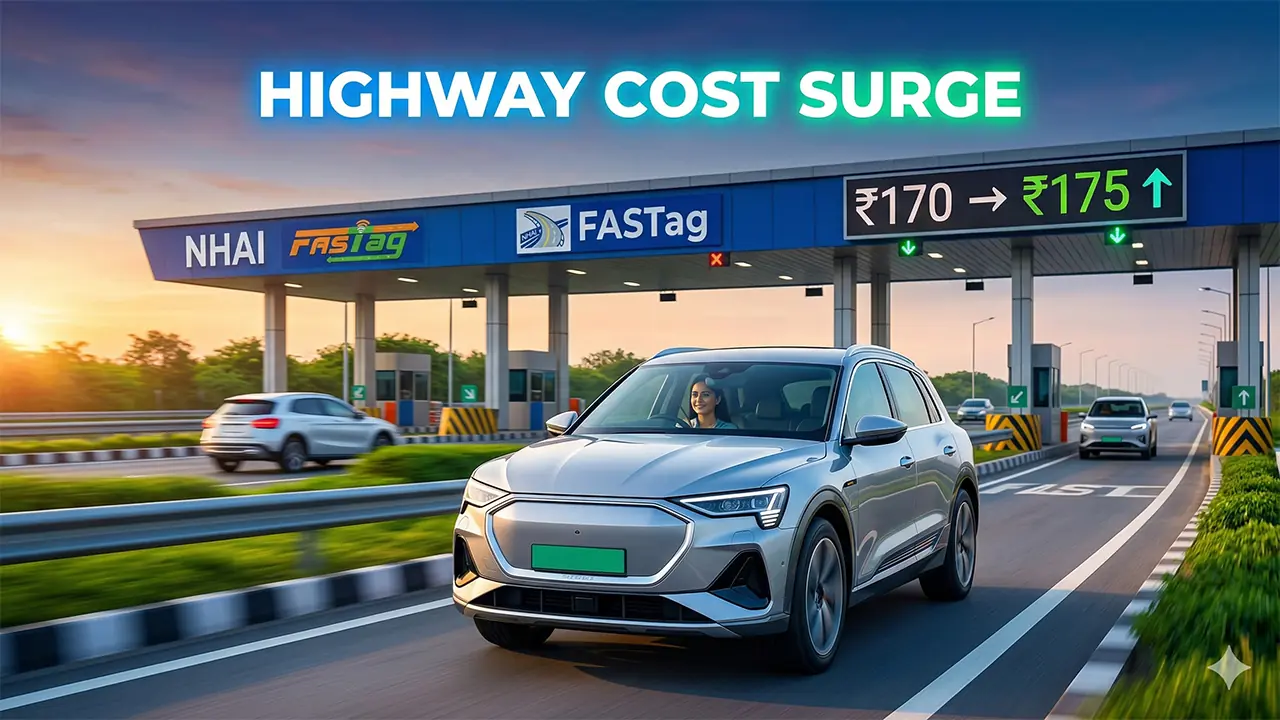
- Light Vehicles (Cars/Jeeps): The one-way journey from Sarai Kale Khan to Meerut will now cost ₹175, up from the previous ₹170. A return journey on the same day will cost ₹265 (a ₹10 increase).
- Indirapuram to Meerut: The rate for cars will increase from ₹115 to ₹120.
- Commercial Vehicles: Light commercial vehicles and minibuses will now pay ₹285 one-way, up from ₹275.
2. Bengaluru-Mysuru Access-Controlled Highway
For commuters down south, the heavily utilized Bengaluru Mysuru expressway toll rate is also undergoing a revision of roughly 3% to 5%.
- At key plazas like Kaniminike and Gananguru, the toll for cars and vans will rise marginally by ₹5 (e.g., from ₹170 to ₹175).
- Heavy commercial vehicles and multi-axle trucks will experience an increase ranging between ₹15 to ₹20.
3. Tamil Nadu and Other Corridors
In Tamil Nadu, user fees at over 60 toll plazas, including the East Coast Road and the Madurai Ring Road, are set to rise. Similarly, vital trade routes on the Delhi-Mumbai corridor, such as the bustling Bharthana toll plaza in Gujarat, will see upward revisions for commercial traffic, though car rates may remain steady in isolated spots.
The End of Cash: 100% FASTag and UPI Mandate
Perhaps the most significant change accompanying the NHAI toll rate hike in India in April 2026 is the complete elimination of cash transactions at major toll booths.
To combat severe traffic bottlenecks and reduce waiting times, the NHAI is strictly enforcing cashless toll plazas in India. For instance, on the Delhi-Meerut Expressway and several other modern corridors, toll operators will no longer accept physical currency.
If you arrive at these plazas, your payment must be processed automatically via an active, fully funded FASTag. In cases where a FASTag scan fails due to technical glitches, commuters will be required to pay the fee using the Unified Payments Interface (UPI) via QR codes available at the booth. This sweeping digital mandate aims to guarantee fully transparent, digital, and seamless movement across state borders.
NHAI FASTag Annual Pass Price Increased
For frequent highway users, daily commuters, and locals living near toll plazas, the FASTag annual pass fee for 2026 is a crucial detail. Initially launched in August 2025 to provide financial relief to frequent travellers, the pass allows unlimited regional travel at a deeply discounted bulk rate.
In line with the general toll rate revisions, the Ministry of Road Transport & Highways has announced that the FASTag Annual Pass will now cost ₹3,075 for the 2026-27 financial year, an increase of ₹75 from the previous ₹3,000 price tag.
Key details about the new FASTag Annual Pass:
- Validity: The pass remains valid for exactly one year from the date of activation or for a maximum of 200 toll plaza crossings—whichever comes first.
- Eligibility: It is strictly available for non-commercial private vehicles (cars, vans, jeeps) equipped with a valid FASTag.
- Activation: Users can easily purchase or renew this pass digitally via the official Rajmarg Yatra App or the NHAI website. Once paid, it binds directly to your existing vehicle’s FASTag within two hours.
If you are a heavy highway user, securing this pass is highly recommended to shield yourself from the daily micro-hikes happening across the network.
Conclusion
The NHAI toll rate hike in India in April 2026 is an unavoidable reality of modern infrastructure development. While a 3% to 5% increase might seem minor for an occasional road trip, it adds up quickly for daily commuters and logistics businesses. To ensure your journeys remain stress-free, double-check your FASTag wallet balance, ensure your KYC is fully updated, and familiarize yourself with UPI payment alternatives before hitting the newly cashless highways this April.
Frequently Asked Questions
Q1. How much is the NHAI toll rate hike in India in April 2026?
Ans: The NHAI has increased toll rates by an average of 3% to 5% across major national highways and expressways, adjusting for annual inflation and the Wholesale Price Index (WPI). The exact amount varies by vehicle type and specific toll plaza.
Q2. Can I still pay cash at Indian highway toll plazas?
Ans: On major modern corridors like the Delhi-Meerut Expressway, cash payments are completely discontinued as of April 1, 2026. Payments must be made exclusively through an active FASTag or via UPI scanning at the booth.
Q3. What is the new price of the FASTag Annual Pass for 2026?
Ans: Effective April 1, 2026, the fee for the FASTag Annual Pass for private, non-commercial vehicles has been increased from ₹3,000 to ₹3,075.
Q4. How long is the FASTag Annual Pass valid?
Ans: The pass is valid for one year from the date of purchase or until you complete 200 toll plaza crossings, whichever occurs first.
Q5. Which major expressways are affected by the April 1 toll increase?
Ans: Almost all major routes fall under this hike, notably the Delhi-Meerut Expressway, the Bengaluru-Mysuru Access-Controlled Highway, the Delhi-Mumbai corridor, and dozens of plazas across Tamil Nadu and Karnataka.