

Imagine pulling up to a petrol pump on a busy morning, only to be refused a single drop of fuel because of one missing document.
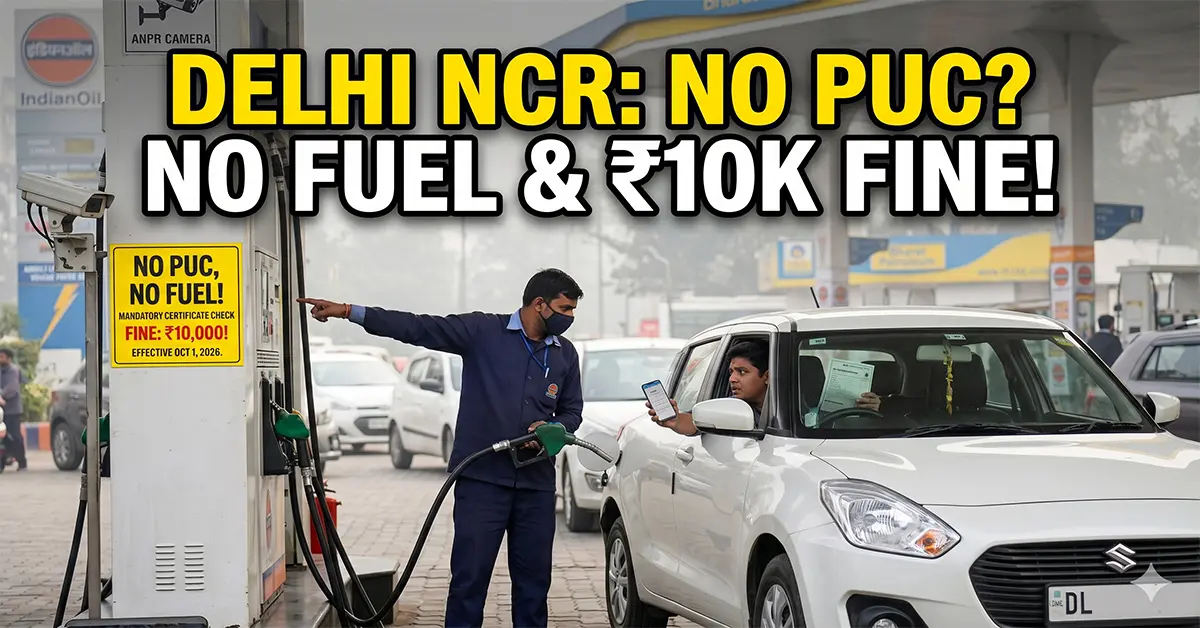
Starting October 1, 2026, the No PUC No Fuel policy in Delhi NCR is becoming a harsh reality for all drivers. In this comprehensive guide, you will discover exactly how this stringent mandate works, the staggering penalties involved, and how to keep your fuel tank full without breaking the bank.
What is the ‘No PUC, No Fuel’ Mandate?
For years, Delhi’s air quality crisis has made global headlines. To combat this severe pollution, the Commission for Air Quality Management has officially issued CAQM Draft Direction No. 101. This strict directive mandates that fuel stations across the entire National Capital Region will deny petrol, diesel, and CNG to any vehicle lacking a valid Pollution Under Control (PUC) certificate.
While the Delhi government tested the waters with this rule earlier in April 2026—turning away over 15,000 non-compliant vehicles in just four days—the official, permanent rollout for the wider NCR begins on October 1, 2026. This is no longer an empty threat or a seasonal Graded Response Action Plan measure; it is a permanent, year-round strategy to enforce strict emission tracking standards and promote breathable air.
Also Read: Bullet 650 vs Classic 650 Comparison: Same Price, Huge Differences!
How High-Tech ANPR Cameras Will Track You Down
You might be wondering: “How will the petrol pump attendants know if my document is expired?” The answer lies in cutting-edge surveillance technology.
Fuel stations across the region have been aggressively equipped with Automatic Number Plate Recognition (ANPR) cameras. These digital eyes serve as the ultimate checkpoint. As soon as you drive into the pump, the cameras scan your registration plate and instantly cross-reference it with the centralised VAHAN database.
- Green Light: If your Delhi NCR pollution certificate is active, you get your fuel without any interruptions.
- Red Light: If your certificate is expired or missing, an automated voice alert is triggered, and the attendant is legally bound to refuse service.
This seamless technological integration ensures there is zero room for bribery, arguments, or human error at the pump.
The Brutal Financial Sting: The ₹10,000 PUCC Challan
Being stranded at a fuel station with an empty tank is embarrassing, but the financial consequences of ignoring this mandate are far more devastating.
If the ANPR cameras flag your vehicle, or if you are pulled over by the Delhi Traffic Police, you will be hit with a massive PUCC challan in Delhi 2026. Under Section 190(2) of the Motor Vehicles Act, driving without an active emissions clearance attracts a severe penalty of ₹10,000. Repeat offenders may even face the risk of license suspension or community service.
Furthermore, the ripple effects hit your insurance. You absolutely cannot renew your annual motor insurance policy without submitting valid emission papers. If you are unfortunate enough to get into an accident, insurance companies will outright reject your claim if your vehicle fails to meet the pollution under control certificate standards. When a simple emissions test costs less than ₹100 and takes only ten minutes, skipping it is simply not worth the risk.
Also Read: Why the BMW M 1000 RR Isle of Man TT Edition is a Masterpiece
Are There Any Exemptions to the New Emission Rules?
While the No PUC No Fuel rule is highly comprehensive, applying to private cars, commercial trucks, and two-wheelers alike, there are a few notable exceptions:
- Electric Vehicles (EVs): Because EVs have zero tailpipe emissions, they do not require a pollution check and are completely exempt from this policy.
- Brand New Vehicles: If you recently purchased a new car or bike, you are granted a temporary grace period. Modern vehicles complying with BS-VI norms typically do not need an emission test for the first 12 months of ownership.
- Emergency Fleets: Ambulances, fire engines, and authorised disaster response vehicles are exempted to ensure public safety operations remain uninterrupted.
Petrol Pump Chaos: The Ground Reality for Dealers
Despite the positive environmental intentions, the on-the-ground execution presents significant hurdles. The Delhi Petrol Dealers’ Association (DPDA) has raised serious operational concerns.
Petrol pump attendants are trained to dispense fuel, not to act as law enforcement officers. Denying fuel—which is classified as an essential commodity—to frustrated, time-strapped commuters could easily spark heated arguments and law-and-order situations at the pumps. Dealers have urged the government to provide legal protection and ensure adequate police presence at high-traffic fuel stations to manage the anticipated chaos.
Conclusion
The relentless enforcement of the No PUC No Fuel policy in Delhi NCR marks a pivotal turning point in India’s fight against toxic vehicular emissions. While the transition may initially be frustrating for daily commuters and fuel station attendants alike, the long-term benefit of cleaner, healthier air cannot be ignored. Ensure your vehicle’s emission status is updated immediately to avoid the heavy ₹10,000 Delhi traffic fines 2026 and the hassle of an empty tank. Do not wait for the October deadline—get tested today.
Also Read: MG Majestor Premium 4×4 SUV Launched: Fortuner Killer at 40.99L?
Frequently Asked Questions (FAQs)
Q1: When does the new fuel mandate officially start in Delhi-NCR?
A: The comprehensive rule takes full effect across the entire Delhi-NCR region on October 1, 2026, as directed by the CAQM’s latest Draft Direction No. 101.
Q2: What is the exact fine for driving without a PUC in Delhi?
A: If caught driving without a valid Delhi NCR pollution certificate, you will be slapped with a heavy e-challan of ₹10,000 under the strict 2026 Motor Vehicles Act updates.
Q3: Does the rule apply to CNG vehicles and two-wheelers?
A: Yes, the mandate strictly applies to all internal combustion engine vehicles. This includes petrol, diesel, and CNG cars, as well as motorcycles and scooters.
Q4: Can I renew my motor insurance if my pollution certificate has expired?
A: No. Insurance companies now legally require an active emissions certificate to process your annual motor insurance renewal or to fulfil any accidental claims.