

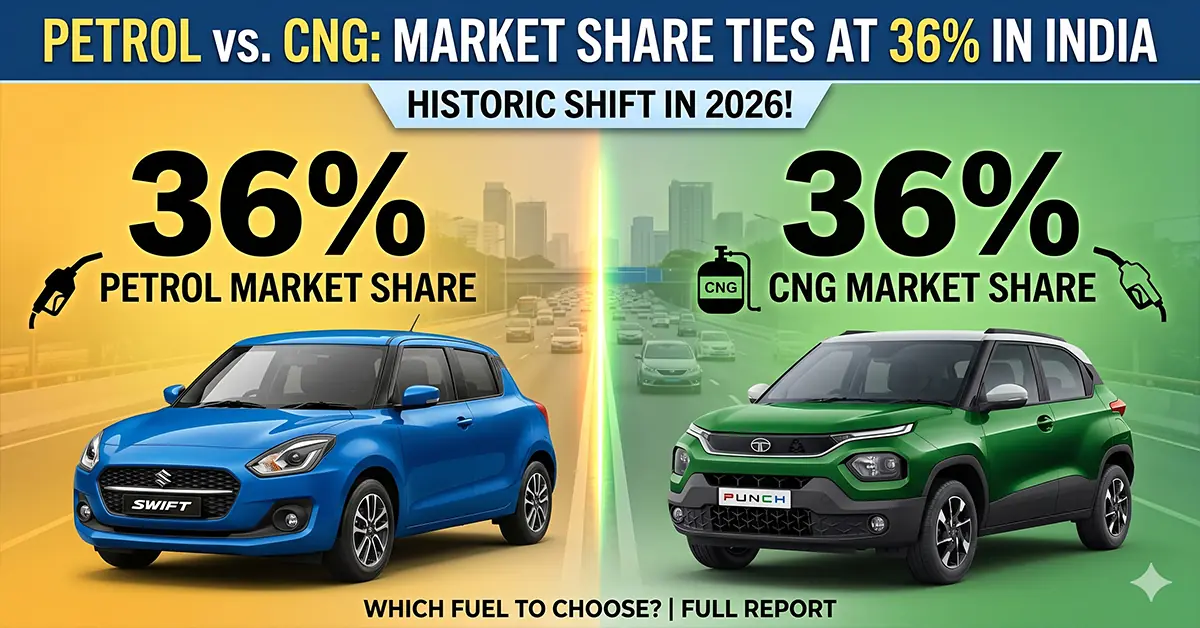
Are you planning to buy a new car this year but feeling deeply confused by the endless fuel options? You are definitely not alone! The automotive industry is undergoing a massive transformation in 2026. Shockingly, the petrol vs CNG market share in india has officially tied at 36% in leading automotive hubs like Maharashtra. If you are wondering whether to stick with traditional petrol or finally switch to natural gas, this guide reveals everything you need to know.
The 36% Tie: A Massive Shift in the Indian Auto Landscape
For decades, petrol was the undisputed king of Indian roads. However, recent data from the FY2026 automotive reports reveals a groundbreaking shift. While petrol still holds around 47% of the total passenger vehicle market nationally, regional data tells a much more aggressive story. In major vehicle-buying states, the market has reached a historic and unprecedented equilibrium: petrol and CNG now hold an identical 36% market share.
This is not just a random spike; it is a structural transformation. Nationwide, CNG car sales have crossed the massive 10-lakh unit milestone, capturing nearly 22% of the overall market and completely overtaking diesel for the second consecutive year. The fact that an alternative fuel has leveled the playing field with petrol in major urban sectors proves that Indian consumers are rapidly prioritizing daily cost-efficiency and sustainability over traditional norms.
Also Read: The New Volkswagen ID Polo EV Unveiled: The Ultimate Budget EV?
Top Reasons Fueling the CNG Boom in 2026
What exactly is driving this rapid CNG adoption? It boils down to a perfect combination of economic sense, incredible technological upgrades, and widespread availability. Here are the primary factors contributing to this 36% tie:
- Unbeatable Running Costs: Let’s face it, fuel prices dictate our daily commute. CNG typically costs 40% to 50% less per kilometre compared to a standard petrol vehicle. For high-mileage drivers, the upfront premium of Rs. 80,000 to Rs. 1 lakh for a CNG variant is completely recovered in less than 18 months.
- Rapid Infrastructure Expansion: Range anxiety is officially a thing of the past. The City Gas Distribution (CGD) networks now actively cover over 600 cities across India. You no longer have to wait in mile-long queues to refuel your family car.
- Advanced Factory-Fitted Technology: Gone are the days of clunky aftermarket retrofits that consumed your entire boot space. Leading Original Equipment Manufacturers (OEMs) like Tata Motors and Maruti Suzuki now offer cutting-edge dual-cylinder technology. These factory-fitted CNG cars hide the tanks seamlessly under the luggage floor, giving you maximum safety, full official warranties, and ample storage capacity.
- Feature-Rich Trims: Previously, CNG was exclusively available in base, stripped-down models. Today, you can buy top-tier SUVs and premium hatchbacks equipped with sunroofs, large touchscreens, and automatic transmissions, all running highly efficiently on natural gas.
Also Read: 2026 Bajaj Chetak Arrives: Faster, Smarter, and Cheaper
Will CNG Completely Dethrone Petrol?
While the petrol vs CNG market share in india tying at 36% in critical markets is incredibly impressive, petrol isn’t disappearing overnight. Many car manufacturers who lack EV or diesel portfolios still heavily rely on petrol engines to drive their primary sales. Petrol also remains the default, safe choice for buyers residing in deep rural areas where gas stations are still under heavy construction.
However, CNG is undeniably the “silent disruptor” of 2026. While Electric Vehicles (EVs) dominate the media headlines with a modest 4.5% market share, CNG is actually doing the real heavy lifting in transitioning the masses toward greener alternative fuels. For budget-conscious urban and semi-urban commuters, CNG offers an immediate, practical, and highly affordable solution without the charging anxieties associated with EVs.
Conclusion
The Indian automotive landscape has never been this dynamic. The incredible milestone where petrol and CNG share an identical 36% market share in key states highlights a permanent shift in buyer psychology. If you drive heavily in daily city traffic or frequently cover long intercity distances, investing in a modern CNG vehicle is no longer a compromise—it is one of the absolute smartest financial decisions you can make in 2026.
Also Read: 2026 Renault Triber Price and New Features: Should You Buy It?
Frequently Asked Questions (FAQs)
1. Which Indian states have the highest CNG car adoption?
Ans: States like Maharashtra, Gujarat, and Uttar Pradesh lead the country in CNG car sales. In fact, Maharashtra recently saw CNG adoption match petrol sales perfectly, tying at a 36% market share due to an extensive and reliable refueling network.
2. Is it worth paying extra for a factory-fitted CNG car?
Ans: Absolutely. Factory-fitted CNG vehicles come with specialized suspension setups, upgraded safety valves, zero warranty void issues, and better engine tuning compared to unreliable aftermarket retrofits.
3. Does buying a CNG car mean losing my boot space?
Ans: Not anymore! Thanks to the innovative dual-cylinder technology introduced by top automakers in recent years, the gas tanks are split and placed beneath the luggage area, allowing you to comfortably utilize almost the entire boot space.
4. How much can I really save by switching from petrol to CNG?
Ans: On average, CNG safely reduces your running costs by 40% to 50% per kilometre. If you drive around 1,000 to 1,500 kilometres a month, you can easily save tens of thousands of rupees annually, recovering your initial premium investment within a year and a half.