

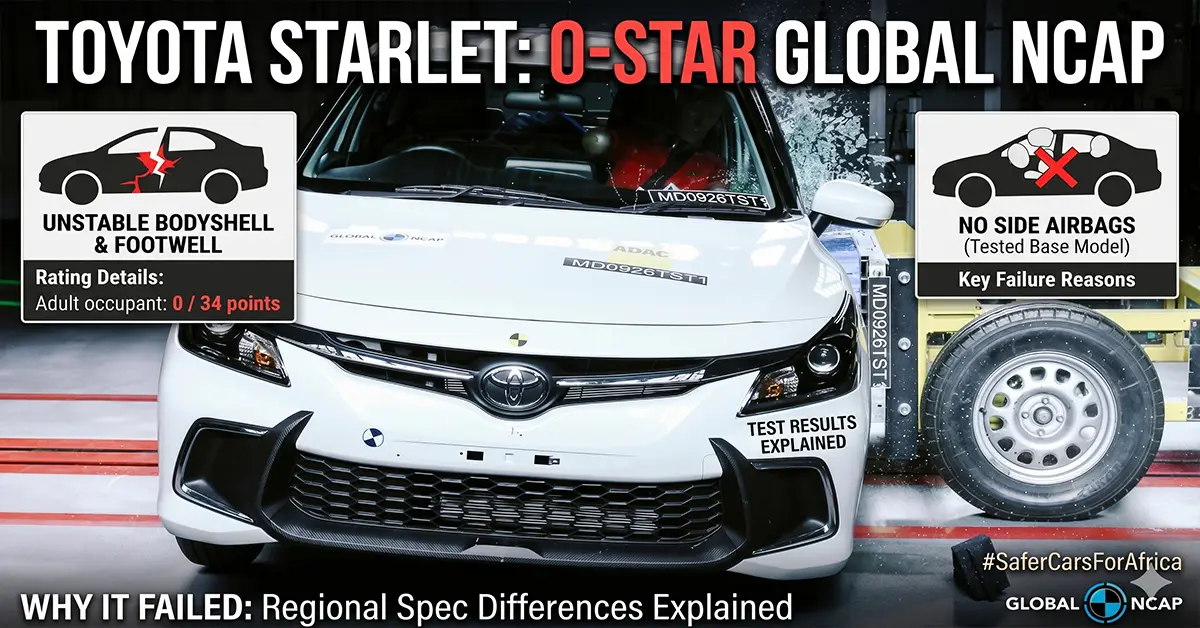
When you buy a brand-new Toyota, you naturally expect top-tier reliability and unwavering safety. However, the latest automotive news has left buyers completely stunned. The outgoing South African-spec Toyota Starlet recently crashed to a highly disappointing Toyota Starlet 0-star Global NCAP rating for adult occupant protection. In this article, we will uncover exactly why this massively popular hatchback failed, what it means for current owners, and how Toyota is responding today.
The Global NCAP Shocker: Breakdown of the Crash Test Results
Evaluated under the rigorous #SaferCarsForAfrica campaign, the results for the outgoing Starlet were deeply concerning. This is particularly alarming because the Starlet is consistently one of the best-selling cars in South Africa, widely used by families, rental companies, and corporate fleets. When a high-volume vehicle receives a 0-star rating, it puts a massive portion of the motoring public at serious risk on a daily basis.
- Adult Occupant Protection (0 Stars): The hatchback scored a dismal 0 out of a possible 34 points. During the frontal offset deformable barrier test, the driver’s chest and lower legs showed only marginal to adequate protection. The major failure happened during the side-movable deformable barrier test, where both head and chest protection were rated as completely poor due to the lack of side airbags.
- Child Occupant Protection (3 Stars): The vehicle scored a slightly better 29.33 out of 49 points for child safety. The 18-month-old dummy was well-protected using standard ISOFIX anchors. However, the 3-year-old dummy’s head made dangerous contact with the interior during frontal impacts, and it remained fully exposed during the side impact test.
Also Read: Massive Fuel Price Hike in India 2026: What to Know
Structural Integrity Flaws and Missing Safety Features
What exactly caused the Toyota Starlet crash test to fail so spectacularly? According to Global NCAP CEO Richard Woods, the overarching problem stems directly from the car’s structural build and its baseline equipment.
- Unstable Bodyshell: The most alarming finding was that the footwell area and the overall bodyshell were officially rated as unstable. This means the car’s physical structure was deemed incapable of withstanding further loadings in the event of a severe crash.
- Lack of Side Airbags: The tested model was equipped with only two frontal airbags as standard. Lacking side head and curtain airbags, the vehicle fundamentally failed to provide necessary life-saving protection during side-impact collisions.
- Skipped Pole Test: Global NCAP completely skipped the side pole impact test because the vehicle did not offer standard side head protection, which drastically lowered its overall safety score.
The India-Made Glanza and Baleno Connection: Is Your Car Safe?
For readers outside of the African continent, this Toyota Starlet safety rating raises immediate and valid red flags. The Starlet sold in South Africa is manufactured in India and shares its exact platform and structural design with the India-made Toyota Glanza and the Maruti Suzuki Baleno.
Why did the Baleno recently score a respectable 4 stars in Bharat NCAP testing while the identical Starlet scored zero in Global NCAP? It entirely boils down to regional testing protocols and standard safety equipment.
The latest India-spec Glanza and Baleno feature six airbags as standard across their lineup. The tested Starlet, however, only featured dual front airbags. This perfectly highlights how the exact same core platform can deliver drastically different safety outcomes based solely on regional market specifications. It reminds buyers that a car’s safety rating in one country doesn’t automatically transfer to an identical-looking model abroad.
Also Read: Why the Tata Altroz CNG Automatic is the Ultimate City Car (From ₹8.69L)
Toyota’s Response and the 2026 Safety Update
Toyota South Africa certainly did not take this Global NCAP 0-star Toyota rating lightly. The automaker issued a swift response, arguing that the tested model is now obsolete. Recognizing the severe safety gap, Toyota has officially updated the South African-spec Toyota Starlet, equipping the newer versions with six airbags (including side and curtain protection) as standard.
However, Bobby Ramagwede, CEO of the AA SA, highlighted a critical moral issue during the backlash: high-standard safety should never be an optional extra reserved solely for stricter European markets. Regardless of local legal loopholes, African consumers deserve the exact same structural safety as global buyers. Global NCAP has already purchased the newly updated six-airbag version and will publish its revised Global NCAP test results very soon.
Conclusion
The recent Toyota Starlet 0-star Global NCAP rating is a harsh wake-up call for automakers and consumers alike. While it is certainly relieving that Toyota quickly updated the model with six standard airbags, the fact that an unstable bodyshell was legally sold to thousands of buyers remains a serious structural concern. Whether you drive an India-made Toyota Glanza, a Maruti Baleno, or a Starlet, it is absolutely crucial to demand advanced safety equipment. Stay tuned as we await the highly anticipated upcoming test results of the newly updated Starlet.
Also Read: Honda NX500 E-Clutch Price in India: Is It Worth It?
Frequently Asked Questions (FAQs)
1. Why did the Toyota Starlet score 0 stars in the Global NCAP test?
Ans: The outgoing South African-spec Toyota Starlet scored zero stars primarily due to an unstable bodyshell, weak footwell integrity, and exceptionally poor head and chest protection during side-impact collisions. The tested base model only had two airbags.
2. Is the India-made Toyota Glanza safe to drive?
Ans: The India-made Toyota Glanza directly shares the Starlet’s platform. However, the current India-spec Glanza offers six airbags as standard and is evaluated under different local testing protocols (Bharat NCAP), ensuring better safety outcomes for its local market.
3. Did Toyota fix the safety issues in the new Starlet?
Ans: Yes. Following the immediate public backlash, Toyota updated the Starlet in the South African market to include six airbags as a standard feature. Global NCAP is currently crash-testing this revised version to verify improvements.
4. Are the Toyota Starlet and Maruti Suzuki Baleno the exact same car?
Ans:Yes, they are mechanically identical. The Toyota Starlet is essentially a rebadged Maruti Suzuki Baleno (also sold as the Toyota Glanza), which is manufactured in India and exported directly to the African market.