

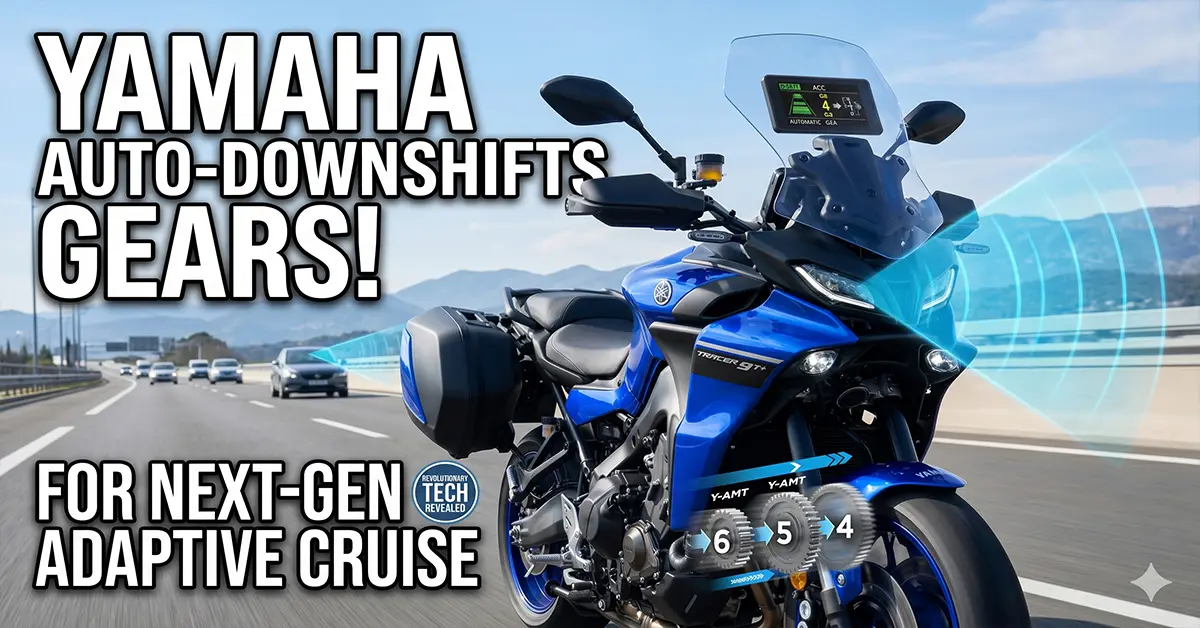
Have you ever experienced that heart-stopping moment on the highway when the car in front of you slams on its brakes, and you have to frantically roll off the throttle, downshift, and grab a handful of brake all at once? It is a scenario every motorcyclist dreads. But what if your bike could anticipate that danger and flawlessly execute those critical, split-second manoeuvres for you, just like a seasoned professional? With the newly revealed Yamaha Advanced Adaptive Cruise Control patent, that futuristic level of safety is moving from science fiction into reality. This groundbreaking radar-aided technology promises to automatically adjust your speed, perfectly matching surrounding traffic by actively managing your gears, signalling a massive leap forward in intelligent two-wheeler rider aids.
What is the Yamaha Advanced Adaptive Cruise Control Patent?
While Adaptive Cruise Control (ACC) has been a standard safety feature in luxury cars for years, its application in motorcycles is relatively new and complex due to the unique dynamics of riding. Traditional motorcycle cruise control simply maintains a set speed. The latest generation of ACC uses front-facing radar to detect vehicles ahead, automatically rolling off the electronic throttle or lightly applying the brakes to maintain a safe following distance.
However, the new Yamaha Advanced Adaptive Cruise Control patent files reveal a critical evolution. The limitation of the current motorcycle ACC is that when a vehicle ahead decelerates sharply, the bike can only rely on its brakes to slow down. If the speed drops significantly without a gear change, the engine can lug or even stall, requiring sudden, panicked manual intervention from the rider.
Yamaha’s brilliant solution, as detailed in these recent patent filings, is to deeply integrate the radar-based ACC system directly with its new Y-AMT (Yamaha Automated Manual Transmission). When the radar detects a slowing vehicle ahead, this next-generation system doesn’t just apply the brakes; it dynamically coordinates throttle reduction, automatic transmission downshifts, and braking pressure simultaneously.
Also Read: Is the Mahindra XUV 3XO the Best Compact SUV in 2026?
How This Motorcycle Radar Technology Thinks Like an Expert Rider
What makes this development so exciting is how it mimics human instinct. When an experienced rider needs to shed speed quickly but stably, they don’t just grab the front brake. They perform a synchronised “techno-ballet”:
- Roll off the throttle to initiate deceleration.
- Downshift rapidly to utilise engine braking, which slows the rear wheel smoothly without overloading the front tyre.
- Apply progressive brake pressure to both the front and rear.
According to the flowcharts within the Yamaha Advanced Adaptive Cruise Control patent, the motorcycle’s onboard ECU (Electronic Control Unit) will automate this exact progressive layering. When the ACC is active and an emergency deceleration is required, the system will instantly reduce throttle, use the Y-AMT to execute perfectly timed downshifts to increase engine braking, and then add hydraulic brake pressure through the Unified Braking System (UBS).
This cohesive approach offers several massive advantages over simply clamping down on the brakes:
- Reduces Front-End Dive: By utilising engine braking first, weight transfer to the front suspension is minimised, keeping the motorcycle balanced and stable, especially mid-corner.
- Prevents Stalling: By keeping the engine in the optimal RPM range through automatic downshifts, the bike is always ready to accelerate safely when traffic clears.
- Reduces Rider Fatigue: Touring riders can manage heavy, fluctuating highway traffic with significantly less physical and mental stress.
The Role of the Yamaha Y-AMT Transmission
This advanced level of Advanced Rider Assistance Systems (ARAS) is only possible because of the semi-automatic gearbox. Yamaha recently launched the Y-AMT system on models like the highly acclaimed 2024 MT-09 and the touring-focused Tracer 9 GT+. The Y-AMT replaces the traditional clutch lever and foot shifter with electronic actuators managed by the bike’s computer. Riders can shift manually via tactile see-saw switches on the handlebar or let the bike shift completely automatically.
Currently, on bikes like the Tracer 9 GT+, the ACC and Y-AMT work together to maintain cruising speeds, but the new patent suggests a future software and hardware integration where the transmission actively participates in emergency deceleration protocols. By linking the radar sensors directly to the transmission actuators, Yamaha is effectively giving the motorcycle a “digital co-pilot.”
Also Read: Maruti & Tata Win Big: May 2026 VAHAN Passenger Vehicle Sales Data
Will This Technology Become Mandatory on Motorcycles?
The automotive industry often previews the future of motorcycle regulations. In many parts of the world, including the European Union and soon the USA, automatic emergency braking systems are becoming legally mandated for new cars to mitigate collisions.
As radar sensors become smaller, cheaper, and more reliable, motorcycle manufacturers are rapidly adopting them. Bosch, a leader in motorcycle stability control, is already supplying radar tech to multiple brands. While the Yamaha Advanced Adaptive Cruise Control patent is currently destined for premium, high-end touring models, industry experts predict that these advanced safety features will inevitably filter down to more accessible mid-range bikes. It is entirely possible that within the next decade, some level of automated collision mitigation could become standard—or even mandated—across the motorcycle industry.
Conclusion
The Yamaha Advanced Adaptive Cruise Control patent represents a watershed moment in two-wheeler engineering. By seamlessly marrying radar perception with the Y-AMT semi-automatic transmission, Yamaha isn’t just making cruise control more convenient; they are fundamentally redefining motorcycle active safety. This technology ensures that the bike responds to sudden traffic changes not just with brute braking force, but with the calculated, balanced finesse of an expert rider. While purists may always prefer a manual clutch, the undeniable safety benefits of this automated downshifting technology will make high-speed touring safer, more relaxing, and ultimately more enjoyable for the next generation of riders.
Also Read: Will the Isobutanol Diesel Blend Mandate in India Hurt Your SUV?
FAQs
1. What is the difference between normal cruise control and adaptive cruise control on a motorcycle?
Ans: Normal cruise control simply holds a static speed set by the rider. Adaptive Cruise Control (ACC) uses a forward-facing radar to monitor the distance to the vehicle ahead. It automatically adjusts the motorcycle’s speed—by rolling off the throttle or gently braking—to maintain a safe, pre-set following gap.
2. How does Yamaha’s new patent improve existing Adaptive Cruise Control?
Ans: Current motorcycle ACC systems rely primarily on the brakes to slow down. Yamaha’s new patent integrates the radar system with an automatic transmission (Y-AMT). If the vehicle ahead slows down, the bike will automatically downshift to utilise engine braking alongside the traditional brakes, resulting in smoother, more stable deceleration.
3. Does this mean the motorcycle drives itself?
Ans: No. This is an Advanced Rider Assistance System (ARAS), classified as Level 1 automation. The rider remains in complete control of steering and balancing and must continuously supervise the road. The system simply manages longitudinal speed and gear selection during cruising to reduce fatigue and improve safety during sudden deceleration.
4. Which Yamaha motorcycles will get this auto-downshift feature?
Ans: While the exact models have not been officially confirmed, this technology is heavily reliant on the Y-AMT automated manual transmission. Therefore, it is highly likely to debut on premium, tech-heavy models that already utilise radar and Y-AMT, such as future iterations of the Yamaha Tracer 9 GT+ or high-end touring variants of the MT series.
5. Can I turn off the automatic downshifting if I want to ride manually?
Ans: Yes. Yamaha’s Y-AMT system, which facilitates this technology, allows riders to switch between fully automatic modes and a manual mode where gears are shifted using a finger-operated switch on the handlebar. If you deactivate the adaptive cruise control, you retain full manual control over gear selection.