

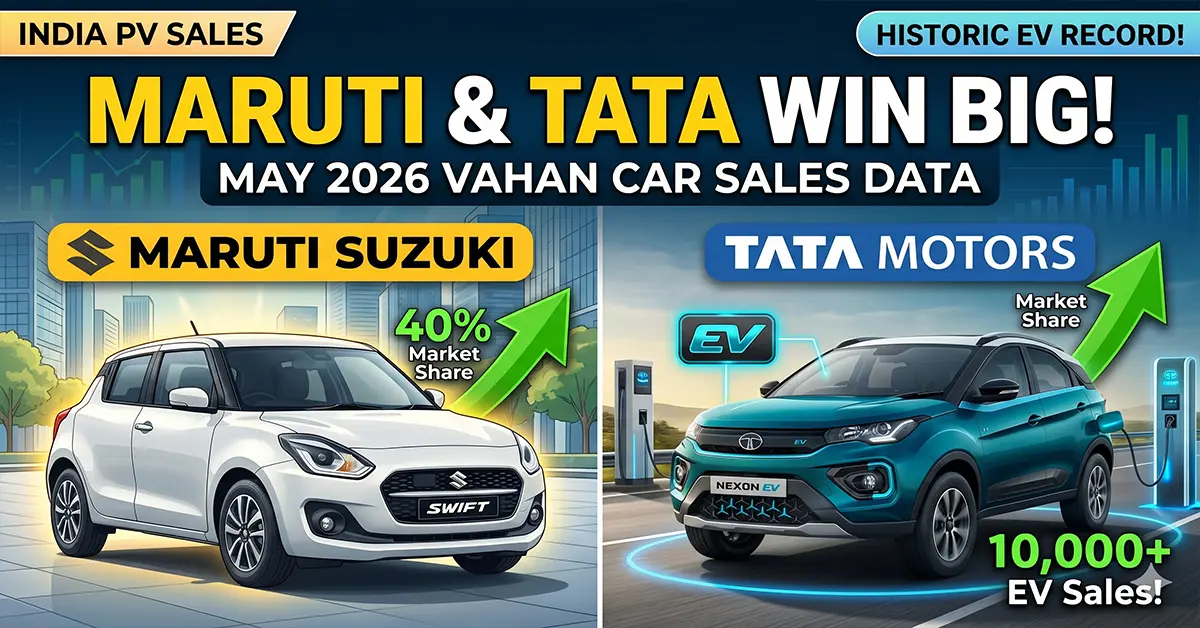
Are you wondering which carmakers truly dominated the Indian auto industry last month? The newly released May 2026 VAHAN passenger vehicle sales data is officially out, and it reveals two massive, industry-shifting truths. While Maruti Suzuki remains the undisputed, unshakeable king of traditional combustion engines, Tata Motors has shattered all previous records in the electric mobility space. Let’s dive deep into these game-changing auto sales numbers and discover what they mean for the future of Indian roads!
Maruti Suzuki’s Unshakeable Grip on the Mass-Market ICE Segment
When it comes to the traditional Internal Combustion Engine (ICE) vehicles, Maruti Suzuki continues to operate in a league of its own. Despite the rapid influx of electric vehicles and hybrid technology, the May 2026 VAHAN passenger vehicle sales data clearly highlights that Maruti Suzuki retains roughly 40% of the overall market share.
But why does the Indian consumer still lean so heavily toward Maruti?
- Unmatched Fuel Efficiency: In an era of fluctuating fuel prices, Maruti’s highly refined petrol and CNG engines remain the top choice for the cost-conscious buyer.
- Deep Rural Penetration: Maruti Suzuki’s vast dealership network reaches corners of India that other automakers simply cannot access.
- Strong ICE Portfolio: Models like the Swift, Brezza, Baleno, and Fronx continue to rake in massive monthly numbers, proving that the mass-market ICE segment is still highly lucrative.
While EV enthusiasts are louder than ever, Maruti’s strategy proves that providing reliable, affordable, and easy-to-maintain vehicles is still the ultimate formula for volume sales in the Indian car market.
Also Read: Will the Isobutanol Diesel Blend Mandate in India Hurt Your SUV?
Tata Motors Makes History: Crossing the 10,000 EV Sales Milestone
While Maruti handles the present, Tata Motors is firmly securing the future. The biggest highlight of the latest VAHAN registrations is Tata Motors officially crossing the 10,000-unit monthly sales mark for electric vehicles. To be exact, Tata EV sales surged to an astonishing 10,517 units in May 2026. This represents a massive 85% year-on-year growth compared to May 2025.
This is not just a win for Tata; it is a monumental milestone for the entire Indian automotive sector. The company has essentially proven that electric vehicles are no longer just a niche luxury; they are ready for mass adoption.
Key Drivers Behind Tata’s Electric Success
How exactly did Tata Motors achieve this historic electric vehicle growth?
- Aggressive Pricing: By introducing cars like the Tiago EV and Punch EV, Tata successfully breached the sub-₹15 lakh barrier, making EVs accessible to the middle-class buyer.
- Diverse Portfolio: Tata offers an EV for every demographic, from the compact Punch EV for city commuting to the premium Curvv EV and Nexon EV for highway cruisers.
- Customer Confidence: Tata’s recent announcements regarding lifetime battery warranties for select models have completely erased range anxiety and battery replacement fears.
- Infrastructure Push: Tata hasn’t just built cars; they have actively collaborated to rapidly expand India’s fast-charging network.
How Do the Competitors Stack Up in May 2026?
Of course, the May 2026 VAHAN passenger vehicle sales data isn’t just about Maruti and Tata. The competition is heating up across the board.
- Mahindra’s SUV Supremacy: Mahindra & Mahindra maintained a fierce grip on the SUV space, clocking over 58,000 domestic SUV sales. Even more impressively, they also recorded their highest-ever monthly EV sales, crossing the 6,000-unit mark for the first time with models like the XEV 9e.
- Maruti Enters the EV Chat: While late to the party, Maruti Suzuki is finally making its presence felt in the electric space. They successfully retailed 1,577 units of their e Vitara, securing a 6% EV market share and proving they intend to compete in the battery-powered space as well.
- Hyundai’s Steady Pace: Hyundai maintained a solid performance, though it saw a slight dip in market share compared to the explosive 42% overall growth registered by Tata Motors this month.
Also Read: ₹10,000 Fine? Surviving the No PUC No Fuel Policy in Delhi NCR
The Broader Impact on the Indian Automobile Market
What does this data actually tell us? The Indian automotive landscape is currently undergoing a beautiful transition.
Retail registrations grew by 5.5% overall in May, but the EV segment specifically jumped by over 40% year-on-year. Consumers are becoming smarter and more demanding. They want the reliability and widespread service network of a Maruti Suzuki, but they also crave the modern technology, silent driving experience, and low running costs provided by Tata’s electric fleet.
For the everyday car buyer, this intense rivalry means better cars, highly competitive pricing, and bleeding-edge technology. Whether you want a trustworthy petrol hatchback or a futuristic electric SUV, the choices available on the showroom floor have never been better.
Conclusion
To summarise, the May 2026 VAHAN passenger vehicle sales data perfectly illustrates a dual narrative in the Indian automotive landscape. On one side, Maruti Suzuki’s absolute mastery over the mass-market ICE segment remains completely unshakeable, driven by consumer trust and affordability. On the other side, Tata Motors has firmly etched its name in the history books by crossing the elusive 10,000-unit monthly EV mark. As charging infrastructure improves and battery technology becomes cheaper, we are guaranteed to see this exciting automotive war escalate in the coming months.
Also Read: Bullet 650 vs Classic 650 Comparison: Same Price, Huge Differences!
FAQs (Frequently Asked Questions)
1. What is the total number of Tata EVs sold in May 2026?
Ans: Tata Motors officially sold an impressive 10,517 electric vehicles in May 2026 across domestic and international markets. This marks an 85% year-on-year growth and is the highest monthly EV sales volume ever recorded by the company.
2. Why does Maruti Suzuki still dominate the Indian car market?
Ans: Maruti Suzuki dominates due to its unmatched dealership network, highly fuel-efficient engines, and a diverse range of affordable ICE and CNG vehicles. Their models cater perfectly to the budget-conscious mass market in both urban and rural areas.
3. Are electric vehicles really becoming more popular in India?
Ans: Absolutely. Based on the latest VAHAN registrations, overall EV sales surged by over 40% year-on-year in May 2026. This growth is driven by expanding charging infrastructure, government incentives, and highly affordable models like the Tata Punch EV.
4. Which company is the second-largest carmaker in India right now?
Ans: According to May 2026 wholesale and retail data, Tata Motors and Hyundai are fiercely contesting the number two spot. Tata secured a highly dominant position this month, backed by a massive 42% YoY growth in overall sales, fueled heavily by their EV and SUV lineup.
5. Will Maruti Suzuki launch more electric vehicles soon?
Ans: Yes, Maruti Suzuki has officially entered the electric space with the e Vitara, selling 1,577 units in May 2026 alone. The company plans to introduce more localised, affordable electric models to the Indian market in the coming years.